

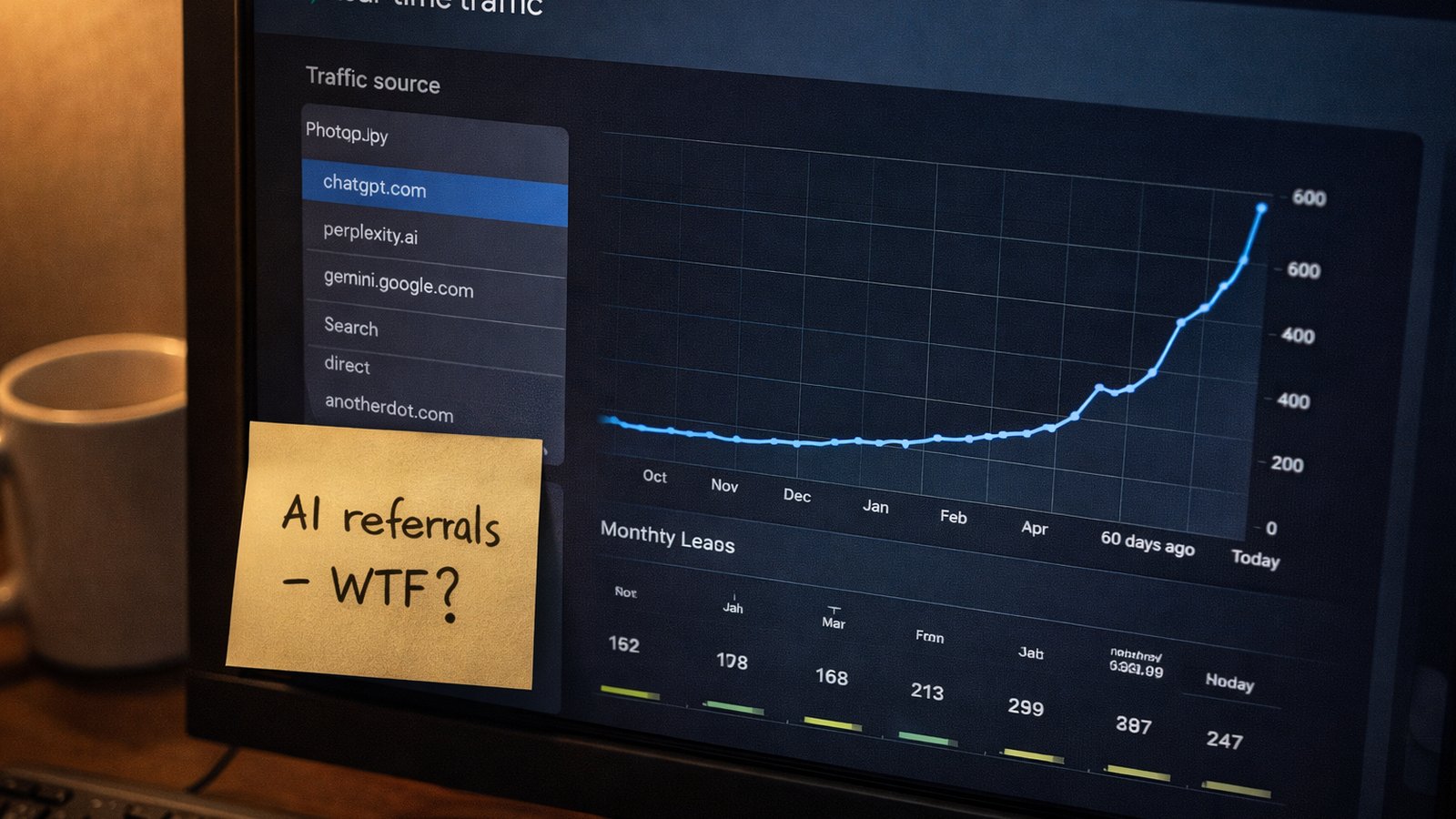
Sometime this year the number reached you. Traffic from AI assistants to dealership websites is up fifteen times in a year. It may have come in an email or on a conference slide, and it usually came with a question about whether your website is ready.
The number is real. It comes from an index published in February 2026 by a software company, drawn from the dealer websites it serves, and it compares this January with the one before. You've been shown large growth figures before, though. You learned to ask what they grew from.
Reading traffic reports for dealers is a regular part of my work. Here is how I'd read this one.
A multiple needs a starting number
The release doesn't give one. It says the traffic grew more than fifteen times. It doesn't say how many visits that was, or what share of a store's traffic they made up.
So supply your own, in round figures. Say a store's website had four visits from AI assistants in a month last year. Fifteen times four is sixty. If that site sees twelve thousand visits a month, sixty is half of one percent.
That store has a fast-growing source and a small one, on the same line of the report. Fifteen times is how fast. Sixty is how many.
Anything new grows like this in its first years, because the year before was close to nothing. A multiple is not a count, it is a rate of change. A store spends and plans on counts.
Your website already holds the count
Your site's analytics records where each visit came from. A visit that arrives by a link in an assistant's answer is filed under that assistant's web address, the way a visit from a news site would be.
Ask whoever keeps your analytics for last month's figures: visits from AI assistants, total visits, and the leads that came from the first group. It's a short job. Then do the division yourself, and set the result beside the sources you already know, your search traffic and your paid ads. That gives it a scale.
Read it with two cautions. The count runs low. A shopper who reads an answer and then phones the store, or searches your name, was sent by the assistant and arrives looking like everyone else. What the assistant told her before she came is its own job, and a separate piece covers how to check it.
The second caution is size. At sixty visits, a month with two leads and a month with none look very different and mean about the same. Give a number this small a few months before you judge it.
These visitors do not start at the homepage
Ask for one more column. It is the page each of those visits began on. A shopper who clicks out of an assistant's answer lands on whatever page the answer pointed to. That could be a single vehicle or the service hours.
She has done her asking somewhere else. The page she lands on is the first thing the store itself says to her. Your advertising, your website and your sales floor are one line of work, and this customer joins it in the middle.
Open the top five of those pages on your phone. If the page is a vehicle, is it still for sale at that price? Can she ask a question that a person will answer? A page for a unit that sold months ago is a dead end, and the store never knew it was there.
The count sets the budget
A fast-growing figure attracts offers. A rebuilt website. A package that promises to make the store ready for AI. Some of that work is worth doing, and your own count tells you how much of it and how soon.
At half a percent of visits, the source has earned your attention. At five percent it has earned a line in the plan. You can't tell which store you are from a figure pooled across thousands of other stores.
There is one thing to ask your website provider now, because the answer is a plain fact. Every site has a small file called robots.txt. It tells automated visitors which pages they may read. Ask whether yours turns away the crawlers the AI assistants send, and if it does, who decided that.
Either answer can be the right one. It ought to be somebody's decision.
Give the count a row in the monthly report
Add one row to the traffic page of the report you already receive. It holds the visits from AI assistants, their share of the total and the leads they produced. Then watch it.
A row does what a headline can't. It shows your store's own rate, which may be faster or slower than fifteen times. It also lets you set a line today, one percent or three or whatever suits you, and know the month you cross it.
When that month comes you'll be deciding from a year of your own figures, so the question of what to spend will be an easy one, and nobody will have to sell you the answer.
Sixty visits are sixty people
It would be easy to read half a percent and close the file. Each of those visits was a person. Somewhere in your market a household is replacing a vehicle. Someone asked an assistant what they once would have asked a neighbour, and the answer had your store in it.
Your people genuinely want that customer looked after. They have no way to see that she arrived differently, or that the page she landed on had gone stale. The row is how the store notices her.
Ask for your own number this week
This week, send one note to whoever keeps your analytics. Ask for last month's visits from AI assistants, the total, the leads, and the pages those visits began on. Divide the first by the second. Write the answer down with the date.
Then open the top pages on your phone and fix what's out of date. Put the robots.txt question to your website provider. Ask for the row to be added to next month's report.
After that you'll have your own number, and you can stop borrowing someone else's.