

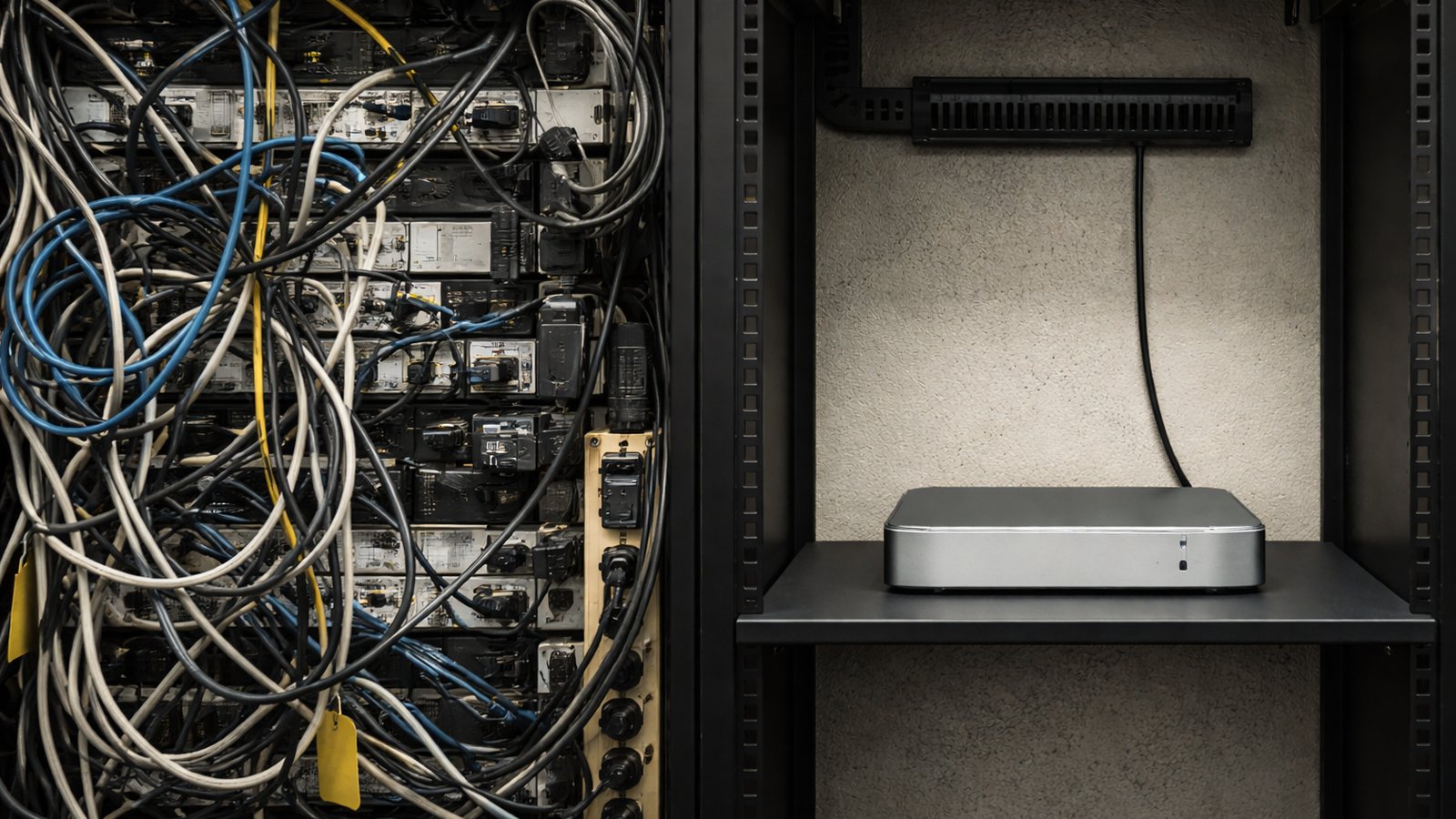
Enterprise AI platforms from your DMS or CRM provider promise seamless integration and one-vendor simplicity. But when your AI is built by the same company that controls your data, sets your integration fees, and profits from your switching costs, the incentives are misaligned. Independent AI platforms — purpose-built for dealer outcomes and accountable to dealer results — consistently deliver faster innovation, lower total cost, and fewer strings attached. This is the foundation of the Diablo AI engine.
1. The AI Gold Rush in Automotive Retail
More than 40 AI-focused exhibitors showed up at the 2026 NADA Show. AI adoption among dealerships reportedly surpassed 48% in 2025, with projections suggesting 70% by the end of 2026. But as we detail in our AI BDC vs. human BDC comparison, adoption alone does not guarantee results.
Here is the reality most vendors will not tell you: the technology underneath most automotive AI products is remarkably similar. The large language models, the machine learning, the automation frameworks — these are commoditized capabilities. The real differentiator is not the model. It is the business model.
Specifically: does your AI vendor make more money when you succeed, or when you stay locked in?
2. What the Incumbents Are Selling
Cox Automotive
Cox showcased AI powered by 5.1 trillion vehicle insights and 2.9 trillion consumer data points across 13 brands. Their VinSolutions AI can identify shoppers up to 8x more likely to buy. The limitation: Cox's AI is designed to make Cox's ecosystem stickier. Switch your CRM away from VinSolutions, and you lose the AI insights.
CDK Global
CDK unveiled a built-in Customer Data Platform at NADA 2026. The limitation: In January 2025, CDK agreed to pay $630 million to settle antitrust claims from 243 software vendors who alleged CDK restricted their access to dealership data. Separately, CDK paid $100 million to settle a dealership class action. Then in June 2024, a ransomware attack shut down CDK's systems for nearly two weeks, with dealer losses estimated at $1.02 billion.
Tekion
Tekion has raised $600 million at a $4 billion valuation for an AI-native, cloud-first DMS. The limitation: Tekion's AI is not available to dealers on CDK or Reynolds. It is a feature of the platform, not an independent tool.
Fullpath
Fullpath launched an Agentic CRM at NADA 2026 with 200+ pre-built integrations. The limitation: Fullpath is building toward a full ecosystem — the trajectory is to become the platform you cannot leave.
3. The Lock-In Problem
The pattern across every incumbent is the same: AI is the feature, lock-in is the business model.
How Lock-In Works in Automotive
- Data gravity. Your DMS holds years of transactional data. Migrating this data is technically complex and sometimes deliberately obstructed.
- Integration fees. Third-party vendors pay fees to read or write data to your DMS. When those fees increase, your vendor costs go up.
- Contractual lock-in. Multi-year contracts with auto-renewal clauses and steep early-termination penalties.
- Workflow dependency. Retraining a 30-person dealership on a new DMS takes months of reduced productivity.
The Landlord Problem
When you rent your AI from your DMS provider, you are a tenant. The landlord decides what upgrades you get, when you get them, and how much you pay. When you own your AI through an independent provider, you are the homeowner. You decide what tools connect. You control your data.
4. Why Enterprise AI Optimizes for the Platform, Not the Dealer
Incentive Misalignment #1: Feature Prioritization
A dealer might benefit most from an AI that integrates with a competitor's CRM. An independent vendor would build that integration. A platform vendor has no incentive to make their AI work better with a competitor's product. This flexibility is critical for solving the afterhours lead response gap regardless of your existing tech stack.
Incentive Misalignment #2: Innovation Speed
Enterprise platforms ship on enterprise timelines — compliance reviews, cross-product dependencies, thousands of existing customers. Independent companies integrate new AI capabilities in weeks. In AI, where technology evolves every quarter, speed is a competitive advantage.
Incentive Misalignment #3: Pricing Transparency
Platform vendors bundle AI into existing subscriptions. Independent vendors price standalone — you compare them to any alternative on merit.
Incentive Misalignment #4: Data Leverage
When your AI and your DMS are the same company, the insights reinforce the value of the DMS. An independent vendor does not own your data pipeline and cannot use data gravity as a retention mechanism.
5. The Independent Advantage
Independent AI vendors survive only if dealers get results — it is why our clients stay. This produces four structural advantages:
- Speed. Adopt new AI capabilities as fast as the technology evolves.
- Focus. Every engineer and every dollar of R&D is focused on making the AI better.
- Accountability. Deliver measurable outcomes or lose the customer.
- Openness. Integrate with whatever the dealer uses — CDK, Reynolds, Tekion, any CRM.
6. Enterprise AI vs. Independent AI
| Factor | Enterprise AI (DMS-Bundled) | Independent AI |
|---|---|---|
| Data Ownership | Data lives inside vendor ecosystem | Data stays in your systems |
| Switching Cost | High — AI embedded in platform | Low — cancel without disrupting DMS |
| Integration Breadth | Deep within own ecosystem; limited outside | Broad by necessity |
| Innovation Speed | Enterprise cycles (quarterly to annual) | Startup cycles (weekly to monthly) |
| Pricing Transparency | Bundled with platform | Standalone, comparable pricing |
| Dealer Focus | AI is one feature among many | AI is the entire product |
| Risk Concentration | Single point of failure | Diversified stack |
7. What to Ask Before You Buy AI From Your DMS Provider
- Can I export all the data the AI generates? Insights, scores, conversation histories, workflow configs.
- Does the AI integrate with non-[vendor] products? If "it works best with our CRM," that is a lock-in signal.
- What does the AI cost independent of the platform subscription? Ask for a line-item breakdown.
- What is the release cadence for AI features? Quarterly enterprise cycles or continuous deployment?
- What happens to my AI if I switch DMS providers? If it only works on their platform, you are buying lock-in.
- Can I run a 30-60 day pilot before committing? If they refuse, ask why.
- Who controls the AI's training data? Is it trained on your data, aggregated industry data, or their proprietary dataset?
- What is the vendor's revenue model for my data? Ask directly: do they monetize your data?
8. The Future: Open Ecosystems Win
The trend in enterprise technology — across every industry — is away from monolithic platforms and toward open ecosystems. In healthcare, fintech, and e-commerce, specialists with open APIs are challenging legacy platforms.
Automotive retail is following the same trajectory. The dealership tech stack is broken — 8 to 10 systems that do not communicate. The solution is not to consolidate under one vendor. It is to build an interoperable stack where each tool is best-in-class and data flows freely.
The dealers who will win in 2026 and beyond are the ones who own their data, choose their tools independently, and hold every vendor accountable. They are homeowners, not tenants.
Independent AI is not just a better product model. It is the right side of history.