

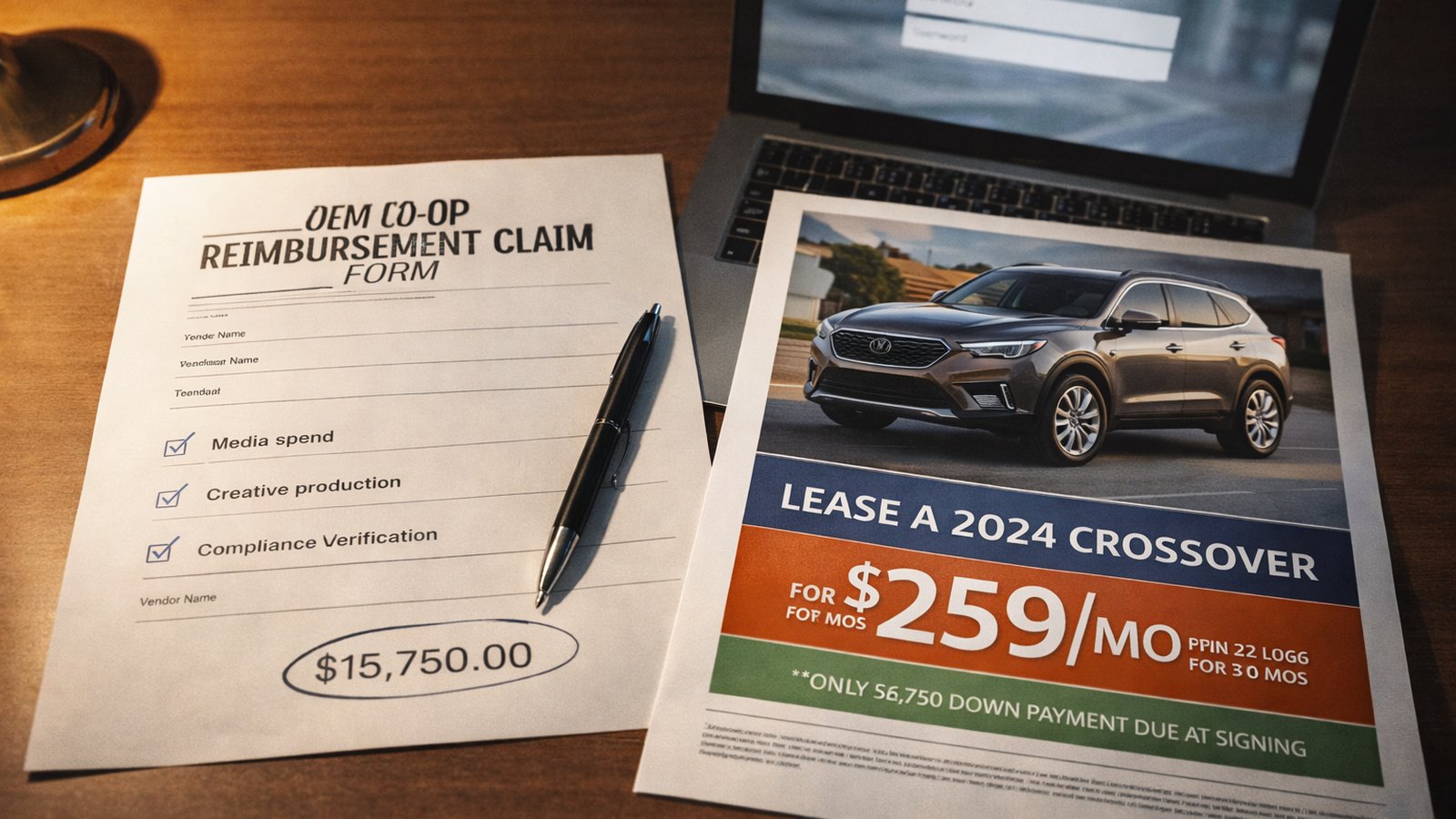
Every franchise dealer knows co-op exists. The manufacturer sets money aside as you buy or sell its vehicles, and pays part of your advertising back out of it when the advertising follows the rules. Ask a principal for today's balance and the date it expires, though, and the answer is usually a name: the person who would know.
I've owned advertising agencies for 25 years, and to me co-op is mostly a matter of dates. The money is earned in one month and has to be collected in another. By then it's a new month.
The claim comes due after everyone has moved on
Follow one campaign. The ad runs in March and the invoices arrive in April. The claim, with its proof attached, is due by a date the program sets, often weeks after the ad came down. Nothing about April reminds anyone of March.
The work also crosses three desks. Marketing chose the ad. The office holds the invoice. The supplier has the screenshots and the run dates.
Each desk did its part. The claim needed all of it in one submission by one date. So the claim belongs to whoever has time, and near the end of a month that is nobody, and the money a store earned one vehicle at a time lapses without anyone having decided to give it up.
Read this year's rules for your own program
Co-op is not one program. Each manufacturer writes its own and most revise it every year. A Canadian store's rules usually come from the manufacturer's Canadian arm, so an article about an American program, or about last year's, can be wrong for you in ways that cost money. Four things in the current rules are worth knowing without having to look them up:
- How the fund builds. It is usually tied to the vehicles you buy or sell.
- What share comes back. Programs pay back part of an eligible ad, and the share can change with the kind of advertising.
- When the balance expires. Some run by the quarter, some by the program year.
- How long you have to file. The clock usually starts when the ad runs.
Before the ad runs
Many claims are lost before the campaign starts. The usual reasons for a denial are plain ones: creative that needed approval and never got it, an old logo, a missing disclaimer or model name, a competitor mentioned in the copy, or a supplier the program doesn't recognize where it requires an approved one. None of it is exotic.
All of that is easy to get right at the start and impossible to repair afterward. The check belongs in the plan. Before anything is booked, somebody reads the ad against this year's guidelines and, where the program asks for it, sends it in for approval. Build the waiting time into the schedule.
While the ad runs
Keep the proof as you go. It's easy to collect during a campaign and hard to recreate after one. Open a folder the day the ad starts and keep four things in it: the ad itself, the invoice, the dates it ran, and a screenshot or photo of it in place.
Events are where this bites. In August 2025, Powersports Business, a trade magazine for a neighbouring industry with the same kind of programs, described a dealer who lost more than $13,000 in co-op because the store didn't have the required photos from an event. The event happened and the money was spent. The photos were the claim.
After the ad runs
File monthly, even when the deadline is quarterly. A monthly claim is small. The campaign is still fresh, and a problem with one claim shows up while there's time to fix the next. A quarter's worth filed in the final week leaves no room for a question from the program.
Then read the denials. A denied claim comes back with a reason, and the reason usually points to a rule someone can follow next time. A store that reads them stops paying for the same mistake.
Co-op pays for the manufacturer's message
Know what the money is for. The manufacturer funds co-op so that its vehicles are advertised locally, in its own look and language, by every store that wears the badge. That's a fair thing for a manufacturer to want, and it's good advertising for the vehicles.
It was never meant to explain why a buyer should choose your store over the one twenty minutes away with the same vehicles. That part is yours to fund. A store that spends only what co-op will match ends up advertising the product well and itself hardly at all, and it will find it difficult to build a name of its own.
A plan should show both budgets. Let co-op pay for the lineup and the current offers, since that is what it was built to do. Put your own money behind your name and behind the three models that carry the month.
Reimbursement is one input. An ad that qualifies and doesn't sell is still a cost, and part of it is yours.
Put the next deadline in your own calendar
Co-op is one of the few lines in the advertising budget where the money is already the store's. Your people earned it every time a vehicle arrived or left. Collecting it is a small job. It needs a date and someone to mind it.
This week, ask for two dates in writing: the day the current co-op balance expires, and the filing deadline for anything running now. Ask for today's balance beside them. Whoever answers is the person minding your co-op, whether or not they knew it.
Then put both dates in your own calendar too. Add a reminder three weeks ahead. If any claims were denied in the last twelve months, ask why. That is enough to keep earned money from expiring quietly.