
The Short Answer
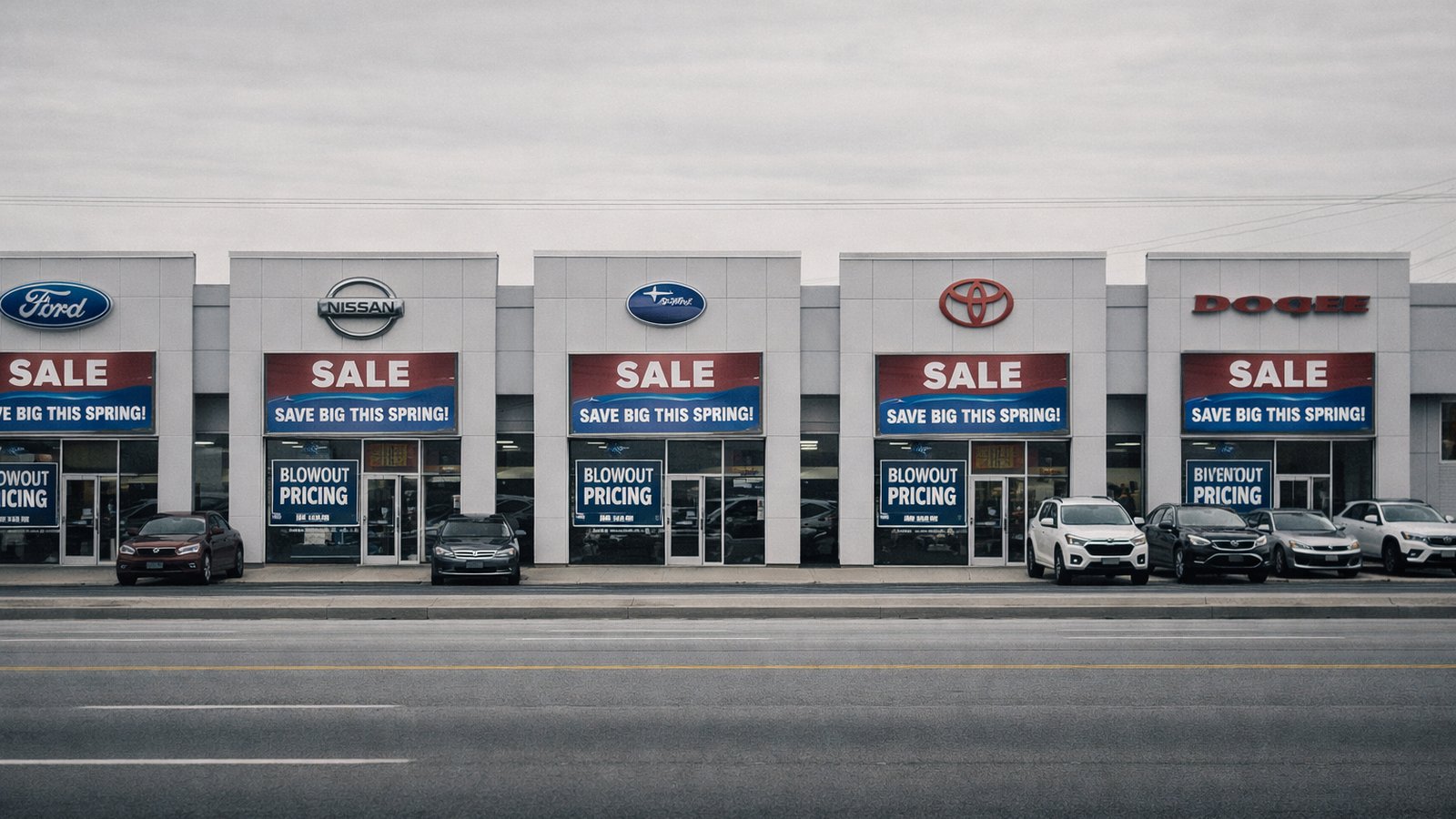
Every franchise dealer operates under OEM brand guidelines -- logo placement, color palettes, fonts, website templates, and advertising standards that ensure manufacturer consistency across thousands of stores. The result: most dealership advertising is interchangeable. Swap the name and address, and a Honda dealer in Phoenix looks identical to one in Toronto. When every competitor looks the same, the only differentiator left is price. And price competition is a margin destroyer — we explore the full economic impact in what happens when branding disappears. The reality is that OEM compliance requirements are narrower than most dealers assume. The dealers who build recognizable local brands do so within OEM guidelines, not by violating them.
1. The OEM Template Trap
The Commoditization Math
When every Honda dealer in a metro area runs the same template ads with the same OEM photography and the same approved messaging, the consumer sees no difference between dealers. The decision reverts to two variables:
- Price -- "Who has the lowest lease payment?"
- Proximity -- "Who is closest to my house?"
Neither of these variables builds long-term business value. As Branding Strategy Insider (2025) documented, marketers are diluting brands by relying too heavily on promotional programs.
What OEM Sameness Costs You
- Lower customer loyalty. Without a distinct dealer brand, customers have no reason to return to your store versus the competitor three miles away.
- Higher conquest cost. When you look like everyone else, the only way to win is to outspend or underprice your competition.
- Zero brand equity in the business. A dealership with no distinct brand has less goodwill to sell. Haig Partners (2025) consistently notes that brand perception is a key factor in valuations.
- Vulnerability to digital disruption. As Digital Dealer (2025) noted, developing a differentiated local dealer brand is now a competitive necessity.
2. What Co-Op Actually Requires (vs. What Dealers Assume)
What Co-Op Programs Typically Require
| Required Element | What It Means | How Strict |
|---|---|---|
| OEM logo usage | Logo must appear at specified size and placement | Strict -- exact specs per brand |
| Approved color palette | Primary brand colors must be present | Moderate -- some flexibility in accent colors |
| Approved fonts | OEM typeface must be used for certain elements | Varies by OEM |
| Mandatory disclaimers | Legal copy, MSRP disclaimers, lease terms | Strict -- must be present and legible |
| Approved vendor list | Media must be purchased through OEM-approved vendors | Strict for co-op reimbursement |
| Pre-approval process | Ads submitted for review before running | Varies by OEM |
| Vehicle imagery | OEM-provided or approved photography for new vehicles | Moderate -- real photos usually acceptable |
What Co-Op Programs Do NOT Require
- "Your dealership cannot have its own visual identity" -- False. You can develop your own logo, color accents, photography style, and brand personality alongside OEM elements.
- "Every ad must use the OEM template" -- False. Most OEMs require their brand elements to be present. They do not require you to use their template layout.
- "Your website must look like every other dealer on the platform" -- Partially false. Most platforms allow custom banners, photography, video, and content.
- "You cannot show your dealership personality in ads" -- False. Your messaging, tone, storytelling, and local personality are entirely yours.
The gap between what co-op requires and what dealers assume it requires is where brand opportunity lives. Our OEM Co-Op guide breaks down the rules for every major manufacturer.
3. The Brand Elements You CAN Control
1. Dealership Logo and Wordmark
Your dealership's own logo is separate from the OEM logo. A custom wordmark or logomark that represents your store's identity is the foundation of differentiation.
2. Brand Voice and Messaging
A dealership that says "We have been part of this community for 35 years, and we treat every customer like a neighbor" has a brand voice. A dealership that says "Come see our great selection and unbeatable prices" does not.
3. Photography and Visual Style
Your dealership can supplement OEM photography with original photography: your actual showroom, your actual team, your actual service department, your actual community involvement.
4. Video Content
A dealership that produces monthly walkaround videos with a consistent visual style and recognizable staff members is building brand recognition that no OEM template can deliver.
5. Community and Cause Alignment
Community alignment builds local brand affinity in ways that advertising cannot replicate.
6. Customer Experience Signature
A dealership known for 5-minute response times and no-haggle pricing has a brand, whether or not it has a logo.
7. Digital Retailing Experience
As more of the purchase process moves online -- 43% of dealers now offer full online purchase capability (Get.Dealer, 2025) -- the digital retailing experience becomes a brand touchpoint.
8. Digital Presence Beyond the OEM Site
Social media, Google Business Profile, review presence, YouTube channel, and any non-OEM web properties are fully within your control.
4. Seven Steps to Build a Dealership Brand
Step 1: Define Your Positioning Statement
A positioning statement answers: "Why should a customer choose us over the identical-looking dealer three miles away?" The answer cannot be price or proximity. Examples:
- "Family-owned since 1982. The owner greets you at the door."
- "The only dealer in [city] with a dedicated EV specialist team."
- "We publish our service pricing online. No surprises, ever."
- "Fastest response in the market -- every lead answered in under 60 seconds."
Step 2: Invest in a Professional Dealership Identity
Budget: $5,000-$15,000 for a solid professional identity system. Larger identity programs from established branding firms can run $25,000-$75,000+ and include market research, positioning strategy, and environmental design.
Step 3: Create a Photography and Video Library
Commission a professional photography session of your facility, team, and community involvement. Supplement with a consistent creative content program -- monthly at minimum, weekly at optimal.
Step 4: Develop Your Brand Voice
| Brand Voice Attribute | What It Means | Example |
|---|---|---|
| Tone | Formal, casual, authoritative, friendly | "We are here when you need us" vs. "Got questions? Hit us up" |
| Vocabulary | Industry terms or plain language | "Vehicle" vs. "car," "pre-owned" vs. "used" |
| Values emphasis | What you lead with | Community, transparency, expertise, speed |
| Personality | Who your dealership would be as a person | The trusted neighbor, the knowledgeable friend |
Step 5: Build a Local Content Program
Publish content that no OEM and no competitor can replicate:
- Community event coverage -- "We were at the [City] Food Bank Drive this weekend"
- Staff spotlights -- "Meet Sarah, our Service Manager with 15 years of experience"
- Local market insights -- "Here is what tariffs mean for [Brand] pricing in [City]"
- Customer stories -- real customers, real experiences, with permission
- Behind-the-scenes -- how your detail shop operates, how your technicians train
Step 6: Ensure Consistency Across Every Touchpoint
| Touchpoint | Brand Consistent? |
|---|---|
| Website hero banner | Uses custom photography, not OEM stock |
| Google Business Profile | Professional photos, complete info, active review responses |
| Social media profiles | Consistent logo, bio, visual style |
| Email signatures | Professional, branded, consistent across staff |
| Showroom signage | Reflects dealership identity alongside OEM branding |
| Follow-up communications | Voice and tone match brand guidelines |
| Review responses | Consistent tone, personalized, timely |
Step 7: Measure Brand Impact
| Brand Metric | How to Measure | What It Indicates |
|---|---|---|
| Branded search volume | Google Search Console | Awareness and recall |
| Direct traffic | Google Analytics -- users who type your URL directly | Top-of-mind recognition |
| Review volume and sentiment | Google, DealerRater, Yelp | Customer perception |
| Social media engagement rate | Native platform analytics | Content resonance |
| Repeat customer rate | CRM -- % of sales to returning customers | Loyalty and retention |
| Cost per conquest vs. retention sale | CRM + ad attribution | Brand premium on acquisition efficiency |
5. Examples That Work
The Community-Rooted Group
Some of the strongest dealership brands are multi-generational family operations woven into the fabric of their communities. They sponsor local events, their owners sit on community boards, and their name is recognized independent of any manufacturer affiliation. What makes this work: the brand is built on relationships and history that no competitor can replicate.
The Experience Differentiator
Some dealers build their brand around a distinctive customer experience. Published pricing. Guaranteed buyback programs. A customer lounge that looks like a boutique hotel rather than a waiting room. The brand promise is tangible and verifiable.
The Digital-First Personality
A growing number of dealers build brand through content -- YouTube channels with model reviews, TikTok accounts with behind-the-scenes content. A recognizable personality attached to a dealership creates trust that template advertising cannot generate.
The Specialist Niche
Some dealers build brand by becoming the recognized authority on a specific segment: the EV dealer, the truck dealer, the luxury pre-owned specialist. Specialization creates perceived expertise that commands premium pricing.
6. Measuring Brand Impact: The Numbers That Matter
Short-Term Indicators (30-90 Days)
- Social media engagement rate -- increasing engagement on branded content indicates resonance
- Review velocity -- more reviews per month suggests increasing customer motivation
- Website direct traffic -- growth in users who navigate directly indicates awareness
Medium-Term Indicators (3-6 Months)
- Branded search volume -- more people searching your dealership name means more awareness
- Repeat customer percentage -- if brand efforts are working, return rates increase
- Cost per conquest sale -- a strong brand reduces the ad spend needed to win a new customer
Long-Term Indicators (6-12+ Months)
- Customer acquisition cost trend -- a recognized brand requires less paid media
- Price sensitivity reduction -- customers choosing you without price comparison
- Referral rate -- organic word-of-mouth measurable in CRM source data
- Goodwill valuation -- brand equity directly influences the goodwill multiple
7. The Honest Limitations
- Franchise agreements extend beyond co-op. Before investing in brand elements that touch the physical facility or OEM-certified website, review your franchise agreement's image and identity clauses.
- Co-op compliance is brand-specific. Multi-franchise dealers must maintain separate compliance for each OEM. The solution is a strong umbrella identity with OEM-compliant sub-brands.
- OEM website platforms limit customization. Supplementary web properties (social media, YouTube, Google Business Profile) provide additional brand expression space.
- OEM programs change. Build your identity on elements you fully control (voice, community, experience) rather than elements subject to OEM approval.
- Brand building takes time. Consistent execution over 6-12 months is the minimum timeline to see measurable impact.
- Not every dealer needs a category-defining brand. Brand investment makes the most sense in competitive metro markets where multiple same-brand dealers compete.