
1. What OEM Co-Op Is (and Why It Exists)
OEM co-op advertising is a reimbursement program where the vehicle manufacturer pays back a portion of a dealer's advertising spend — typically 50% to 100% of eligible expenses — provided the advertising meets the manufacturer's brand guidelines and compliance requirements (AutoVerify, 2025). The average franchised new-car dealership spent $543,539 on advertising in 2024 (NADA Data, 2024). For a dealer receiving 50% co-op reimbursement on the majority of that spend, the program represents $200,000-$270,000 in recovered costs annually. It is not a perk. It is a structural component of dealership profitability.
Co-op exists because OEMs need their dealers to advertise. The manufacturer runs national (Tier 1) campaigns and regional (Tier 2) campaigns through dealer advertising associations. But the final conversion — getting a buyer into a specific showroom — happens at Tier 3, the individual dealer level. OEMs fund co-op to ensure dealers invest in local advertising that drives traffic to their franchise locations, reinforcing the brand messaging established at Tiers 1 and 2.
The tension is built into the structure. The OEM wants brand consistency across hundreds of franchise points. The dealer wants creative freedom to differentiate in their local market. Co-op programs are the mechanism through which this tension is managed — and the dealer who understands the rules can maximize reimbursement while still building a distinctive local brand.
2. How Reimbursement Works
The Basic Mechanics
Co-op reimbursement follows a standard process across most OEMs:
- Fund accrual. The dealer accumulates co-op funds based on vehicle purchases or sales volume. Funds typically accrue monthly as a dollar amount per vehicle purchased from the manufacturer.
- Campaign execution. The dealer runs advertising that meets the OEM's brand guidelines using approved vendors and approved media channels.
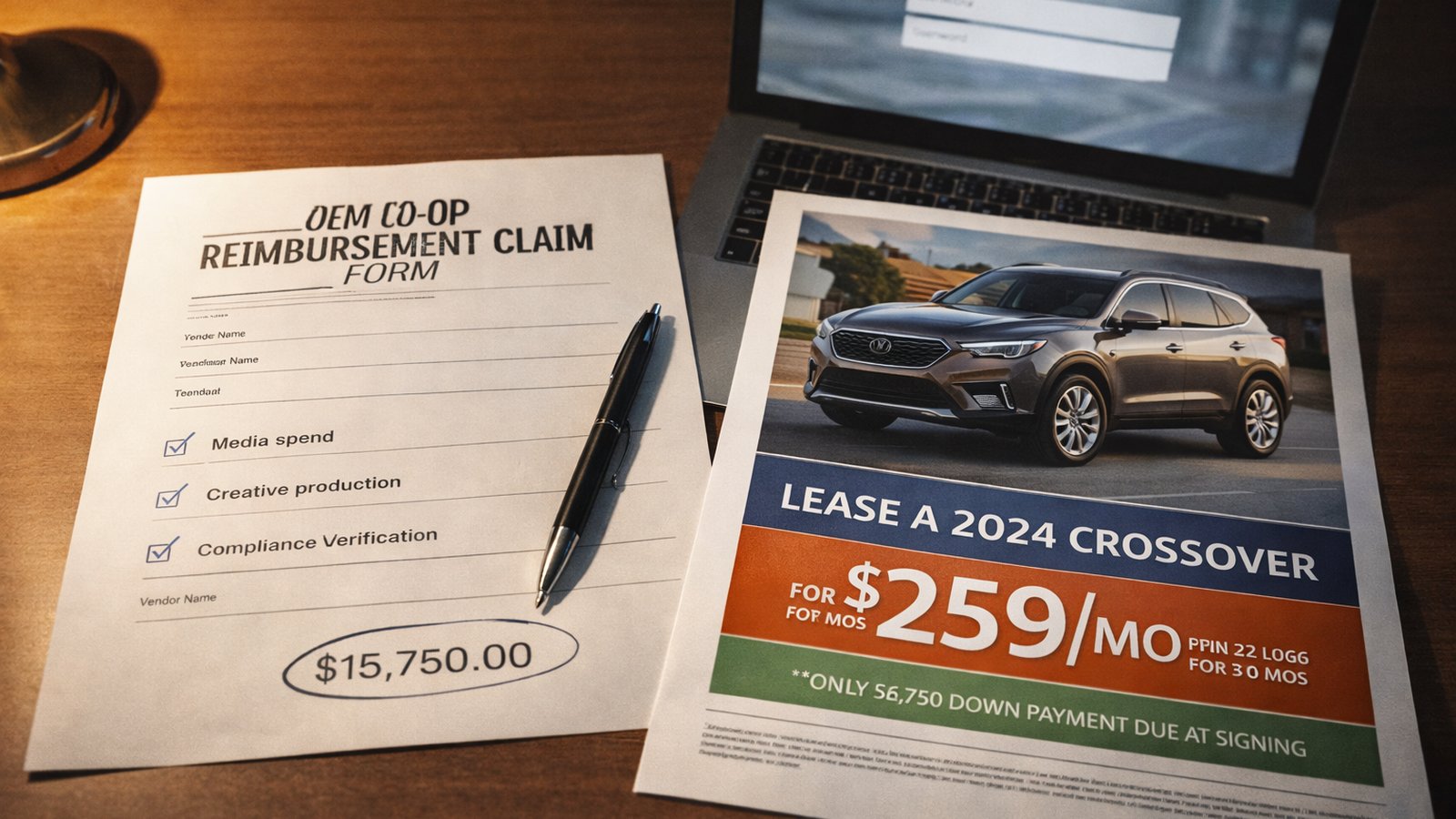
- Claim submission. The dealer submits proof of performance — copies of ads, invoices, media placement confirmations, screenshots — along with a reimbursement claim.
- Review and payment. The OEM (or a third-party administrator) reviews the claim for compliance. If approved, the reimbursement is issued — typically within 30-60 days.
Reimbursement Rates by Structure
| Reimbursement Model | How It Works | Typical Rate |
|---|---|---|
| Percentage of spend | OEM reimburses a fixed % of eligible ad spend | 50-75% |
| Dollar-per-vehicle | OEM accrues a set dollar amount per vehicle purchased | $50-$300 per unit |
| Matched spend | OEM matches dealer spend dollar-for-dollar up to a cap | 100% up to cap |
| Program-specific bonus | Extra reimbursement for participating in specific OEM initiatives | Varies (additional 10-25%) |
The Use-It-or-Lose-It Reality
Most co-op programs operate on a use-it-or-lose-it basis within a defined period — quarterly or annually depending on the OEM. Unused funds expire. According to PowerChord's analysis of dealer co-op utilization, a significant percentage of available co-op funds go unclaimed every year because dealers either do not understand what is eligible, miss submission deadlines, or fail to comply with brand requirements (PowerChord, 2025).
If your dealership is not tracking co-op accrual balances monthly, you are almost certainly leaving money on the table.
3. Major OEM Program Differences
Every manufacturer structures their co-op program differently. The following overview covers the general frameworks of major OEM programs. Specific terms, rates, and requirements change annually — always verify current program details through your OEM portal or dealer association.
General Motors — In-Market Retail (IMR)
GM's IMR program was one of the first to fully embrace digital advertising co-op. The program allows dealers to use co-op funds for paid search (SEM), SEO, social media management, and paid social advertising (C-4 Analytics, 2025). GM requires dealers to work with certified Digital Advertising Partners (DAPs). The program allocates funds based on vehicle sales volume and requires campaigns to run through approved vendor platforms.
Key distinction: GM's program is among the most digital-forward. Dealers can allocate co-op to Google Ads, Meta ads, and website services — not just traditional media.
Ford — FordDirect
FordDirect operates Ford's dealer marketing program. The FordDirect Search Engine Marketing (SEM) program is 100% co-op eligible (FordDirect, 2025). Ford's program emphasizes digital performance marketing and requires dealers to use FordDirect-approved vendors for website, SEM, and digital retailing tools.
Key distinction: Ford's SEM program being fully co-op eligible makes it one of the more generous digital programs, but it restricts vendor choice.
Toyota — Coordinated Marketing and Training Program
Toyota's co-op program often covers up to 75% of eligible advertising expenses (AutoVerify, 2025), making it one of the highest reimbursement rates among major OEMs. The program has traditionally been strong in supporting both traditional and digital media, with specific provisions for local market advertising.
Key distinction: The 75% rate is significantly above the industry-standard 50%, giving Toyota dealers more leverage to invest in quality creative.
Stellantis — T3AC and BCDF Funding
Stellantis (Chrysler, Dodge, Jeep, Ram, Fiat) operates through the Tier 3 Advertising Council (T3AC) and Brand Customized Dealer Funding (BCDF). The program supports paid search, display, video, and social advertising through certified partners (C-4 Analytics, 2025).
Key distinction: Stellantis runs multiple brand-specific programs under one umbrella. A dealer carrying multiple Stellantis brands may have separate co-op pools for each.
Honda — Digital Solutions
Honda's program operates through a certified partner network that covers website services, search advertising, and social media. The program emphasizes dealer website performance and digital retailing integration.
Key distinction: Honda has historically maintained tight vendor control, limiting the number of approved partners for each digital service category.
Comparison Summary
| OEM | Est. Reimbursement Rate | Digital Eligible | Certified Partner Required | Fund Expiry |
|---|---|---|---|---|
| GM (IMR) | 50-100% | Yes — SEM, SEO, Social | Yes (DAP) | Quarterly |
| Ford (FordDirect) | Up to 100% (SEM) | Yes — SEM, Display, Website | Yes (FordDirect) | Quarterly |
| Toyota | Up to 75% | Yes — Broad eligibility | Yes | Annual |
| Stellantis | 50-75% | Yes — Search, Display, Video, Social | Yes (T3AC Certified) | Varies by brand |
| Honda | 50-75% | Yes — Website, SEM, Social | Yes | Quarterly |
Note: Rates and terms are approximate and change annually. Always verify current terms through your OEM dealer portal.
4. What Is Co-Op Eligible (and What Is Not)
Generally Eligible
- Paid search advertising (SEM) — Google Ads, Microsoft Ads when run through approved vendors
- Social media advertising — Meta (Facebook/Instagram) ads, often through certified platforms
- Display and video advertising — YouTube, programmatic display through approved vendors
- Dealer website services — Hosting, SEO, and content through OEM-approved website providers
- Traditional media — TV, radio, print, direct mail (declining share but still eligible)
- Vehicle Listing Ads (VLAs) — Increasingly eligible as Google's Vehicle Ads gain adoption
- Event marketing — Local sponsorships and community events (varies by OEM)
Generally NOT Eligible
- Brand-building content that does not feature OEM vehicles — Your dealership culture videos, team spotlights, and community involvement content will typically not qualify
- Third-party listing sites — AutoTrader, Cars.com, and CarGurus subscriptions are generally not co-op eligible
- Non-approved vendor services — Even if the media channel is eligible, using a non-certified vendor disqualifies the spend
- Comparative advertising — Ads that reference competitor brands or dealerships
- Advertising for non-OEM products — Aftermarket accessories, non-franchise used inventory (varies)
- Social media organic content — Posting on your Facebook page is not an ad spend and is not reimbursable
The Gray Zone
Some categories sit in a gray zone that varies by OEM:
- Inventory photography and video production — Some OEMs reimburse this; others do not
- CRM and marketing automation platforms — Increasingly eligible under digital programs, but not universal
- Reputation management and review platforms — A few OEM programs now cover these
- Facebook Marketplace listing tools — Not typically eligible, but evolving
5. Common Claim Mistakes That Get Claims Denied
According to industry co-op specialists and OEM program administrators, these are the most frequent reasons dealership co-op claims are denied:
Mistake 1: Missing the Submission Deadline
OEM co-op programs have strict deadlines for claim submission. New Holland's program, for example, requires claims within 60 days of ad placement (Dealer Spike, 2025). Miss the deadline and the funds are forfeited — no exceptions, no extensions. Most OEMs operate on quarterly submission windows.
Prevention: Set calendar reminders 30 days and 7 days before each quarterly deadline. Assign one person as the co-op submission owner.
Mistake 2: Using Non-Approved Vendors
The OEM certifies specific vendors for specific services. Running your Google Ads through a non-certified agency — even if the campaign is perfectly compliant in every other way — can disqualify the entire spend from reimbursement.
Prevention: Before engaging any marketing vendor, confirm they are certified for your OEM's current program. Certification lists change annually.
Mistake 3: Brand Guideline Violations
Using an outdated logo, incorrect brand colors, unapproved fonts, or missing required disclaimers can result in claim denial. Some OEMs require specific trademark language — for example, Kawasaki requires the use of trademarked model names like "Ninja" or "Mule" in advertising (Powersports Business, 2025).
Prevention: Download the latest brand asset kit from your OEM portal at the start of each quarter. Review every ad against the current guidelines before it runs.
Mistake 4: Pricing Non-Compliance
Several OEMs, including Nissan, enforce Minimum Advertised Price (MAP) guidelines. Advertising a vehicle below the OEM's minimum price can result in claim denial, fund forfeiture, or even chargebacks against previous approvals (PCG Digital, 2025).
Prevention: Cross-reference all advertised prices against current OEM pricing guidelines before ad launch. Automate this check in your approval workflow if possible.
Mistake 5: Incomplete Documentation
Claims require proof of performance: copies of the ad, invoices from the vendor, proof of placement (screenshots, media receipts, run dates), and the completed claim form. Missing any element results in rejection or delay.
Prevention: Create a co-op documentation folder for each campaign at launch. Collect all required materials as the campaign runs, not after it ends.
The Denial Cost
A single denied claim on a $10,000 campaign at 50% reimbursement is $5,000 lost. Over four quarters, sloppy co-op management can cost a dealership $20,000-$50,000 annually — money that was earned and available but never collected due to preventable administrative errors.
6. Maximizing Co-Op Without Sacrificing Creative
The central frustration for dealers who care about their brand: co-op compliance often feels like a creative straitjacket. OEM templates are generic. Approved imagery is stock photography. Required messaging is manufacturer-centric. How do you build a distinctive dealership brand when your largest marketing budget is governed by someone else's brand guidelines? This is the core tension we address in why OEM templates keep you generic.
Strategy 1: Split Your Budget into Co-Op and Brand
Not every dollar needs to be co-op eligible. The most effective approach is a two-track budget:
- Co-Op Track (60-70% of total spend): OEM-compliant campaigns that maximize reimbursement. These are your paid search, VLAs, OEM-approved display, and compliant social ads. The OEM pays for a significant portion of this — let them.
- Brand Track (30-40% of total spend): Your own dealership brand content. Culture videos, team features, community involvement, customer story content, unique creative campaigns. These are not co-op eligible, and that is fine. This is the investment that differentiates you.
The co-op track keeps the lights on and drives transactional advertising performance. The brand track builds the equity that makes your co-op ads more effective over time because shoppers already recognize and trust your dealership.
Strategy 2: Maximize Creative Within Guidelines
OEM brand guidelines define the floor, not the ceiling. Most guidelines specify:
- Required logo placement and size
- Required disclaimer text
- Approved color palettes
- Approved imagery sources
They rarely prohibit:
- Custom video content featuring your actual dealership and team
- Unique ad copy that speaks to your local market
- Storytelling formats that go beyond "0% APR for 60 months"
- Custom photography of your actual facility and inventory
The best co-op-compliant ads meet every requirement while still sounding like your dealership, not the manufacturer. The disclaimer is in the right place. The logo is the right size. But the message, the voice, and the visual identity are distinctly yours.
Strategy 3: Use Co-Op for Bottom-Funnel, Brand Budget for Top-Funnel
Co-op eligible channels (search, VLAs, approved display) tend to be bottom-funnel by nature. They capture existing demand. Your brand budget should go toward top-of-funnel awareness — the video content, social media presence, and community engagement that creates demand.
This alignment is natural: the OEM wants to fund channels that directly drive vehicle sales (bottom funnel). You want to fund channels that build your dealership's identity and long-term equity (top funnel). Both get funded. Neither is compromised.
7. The Compliance vs. Creativity Tension
Why This Tension Is Structural
OEMs and dealers have fundamentally different objectives in advertising:
| OEM Objective | Dealer Objective | |
|---|---|---|
| Brand | Protect national brand consistency | Build local brand differentiation |
| Message | Promote current incentives and model launches | Drive traffic to this specific dealership |
| Creative | Standardized across all franchise locations | Unique to this market and this team |
| Timeline | Aligned to national campaign calendar | Responsive to local market conditions |
Neither party is wrong. The OEM's need for consistency is legitimate — a Chevrolet dealership in Seattle should not be running ads that contradict the Chevrolet brand promise in Chicago. The dealer's need for differentiation is equally legitimate — a Chevrolet dealership in Seattle needs to explain why a buyer should choose them over the other three Chevrolet dealers within 30 miles.
The Practical Resolution
Accept co-op guidelines as a constraint on form, not substance. You can comply with every logo placement rule, every disclaimer requirement, and every approved vendor mandate while still:
- Writing ad copy that reflects your dealership's personality
- Using photography and video of your actual team and facility
- Running campaigns tied to local events, seasons, and community moments
- Testing creative approaches that no other dealer in your OEM network is running
The dealers who treat co-op compliance as a checkbox — the minimum bar for getting reimbursed — rather than a creative ceiling are the ones who build brands within the system.
When to Opt Out of Co-Op
There are rare cases where the co-op-eligible option is demonstrably inferior to a non-eligible alternative. If your OEM's approved website vendor delivers a measurably worse user experience than an independent option — slower load times, lower conversion rates, worse mobile performance — the co-op reimbursement may not offset the lost sales.
Run the math. If the co-op approved vendor costs $2,000/month with 50% reimbursement (net $1,000) but converts at 3%, and the independent vendor costs $2,500/month with 0% reimbursement but converts at 5%, the independent vendor may generate more gross profit despite the higher net cost. These decisions should be made on P&L impact, not co-op eligibility alone.
8. Adversarial Review: Top 5 Holes in This Article
Hole 1: "Specific OEM program details change annually — this could be outdated."
Correct. Co-op programs are updated annually and sometimes mid-year. The frameworks described here are structurally accurate as of early 2026, but specific rates, certified vendors, and eligible channels should always be verified through your OEM dealer portal or your dealer advertising association. This article is a framework, not a substitute for reading your current program terms.
Hole 2: "You're recommending 30-40% of budget outside co-op — that's a hard sell for cost-conscious GMs."
It is. And for a dealership where every dollar is scrutinized, the counter-argument is: your co-op budget is the manufacturer's brand investment through your dealership. Your non-co-op budget is your dealership's brand investment in itself. The dealers in your market who have real brand equity — the ones shoppers seek out by name — did not build that equity with OEM-templated ads. They invested their own money in their own identity.
Hole 3: "You don't mention Tier 2 advertising associations in depth."
Tier 2 (regional dealer advertising associations) is a significant factor in co-op strategy. Dealers are typically required to contribute to Tier 2 funds, which run regional campaigns. The interaction between Tier 2 contributions and Tier 3 co-op varies by OEM and market. A full treatment of Tier 2 warrants its own article.
Hole 4: "The reimbursement rates cited are ranges, not exact numbers."
By design. Exact rates are contractual, vary by dealer agreement, and change annually. Publishing specific rates risks being misleading. The ranges cited are consistent with industry reporting from AutoVerify, PowerChord, and Dealer Spike.
Hole 5: "You frame co-op as easy money — but the administrative burden is real."
Fair. Co-op claim management is tedious. For a multi-franchise dealer group, it can require a dedicated staff member or agency resource. The administrative cost is real and should be factored into the ROI calculation. That said, a dealership leaving $200,000+ on the table annually because the paperwork is inconvenient is making a $200,000 mistake.