

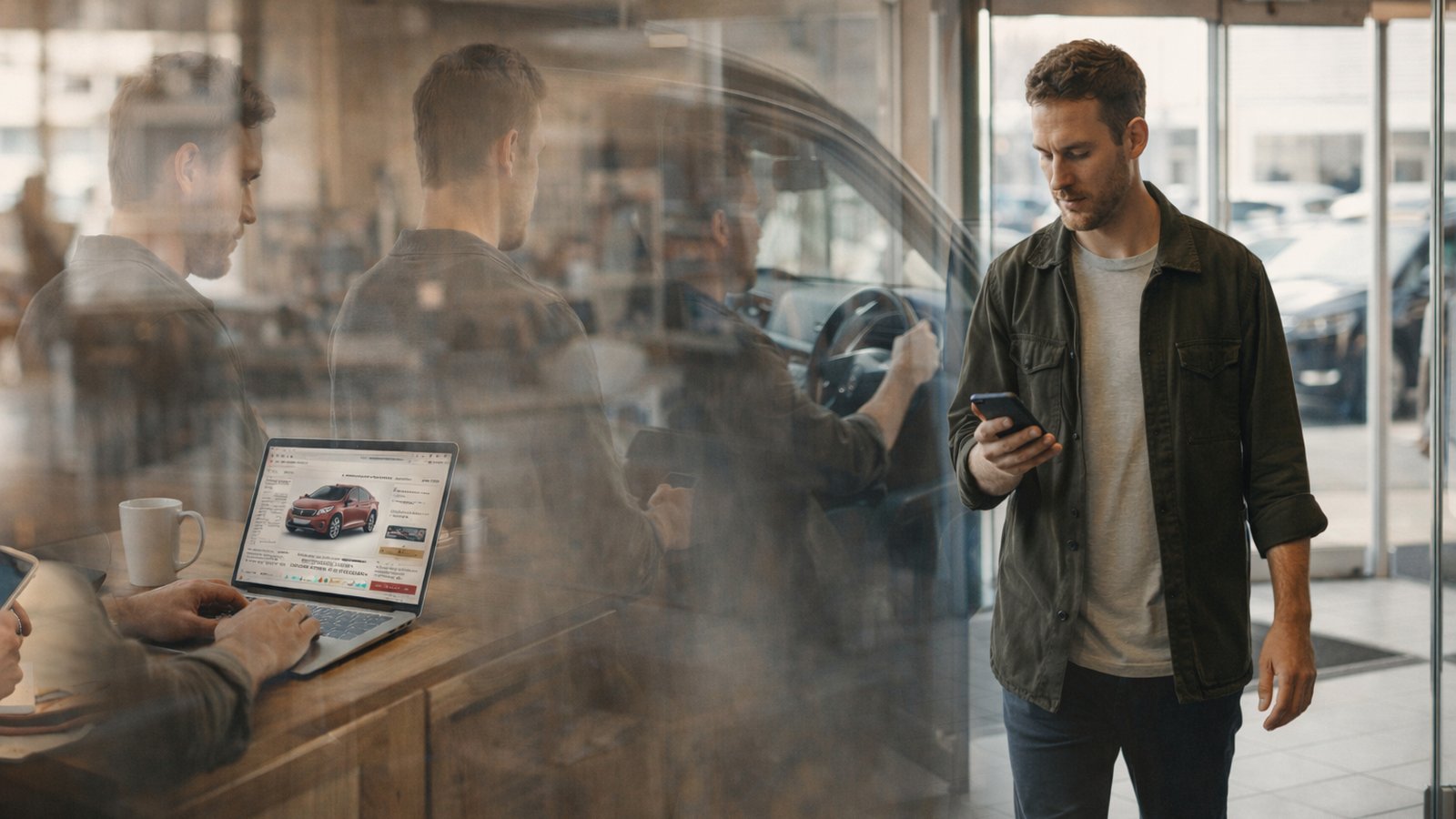
Automotive marketing in 2026 operates in a market where the average franchise dealership spends over $543,000 per year on advertising, 73% of that budget flows to digital channels, and the typical car buyer engages with 24 touchpoints — 19 of them digital — before visiting a single showroom. The dealerships winning today are not the ones spending the most. They are the ones spending with a system — what we call full-funnel domination.
This guide covers every major marketing channel, strategy, and decision a dealership GM or marketing director will face in 2026. It includes current benchmarks, frameworks for budget allocation, and specific guidance on what is working right now.
1. How Car Buyers Shop in 2026
The 24-Touchpoint Journey
The average car buyer engages with 24 total touchpoints during their purchase journey, with 19 being digital. By the time a buyer contacts your dealership, their decision is 80% made.
Where Buyers Start
- Third-party sites remain the starting point for ~80% of buyers
- Dealership websites influence 77% of purchase decisions
- Video content is consumed by 75% of buyers during research
- Social media is used by 60% of buyers, with 44% citing it as the most influential channel
- AI search (ChatGPT, Gemini, Perplexity) — LLM-referred traffic increased 15x year-over-year
71% of all digital automotive interactions happen on mobile devices.
2. Paid Advertising: Google Search, VLAs, and Performance Max
Google Search Ads Benchmarks
| Metric | Automotive Benchmark |
|---|---|
| Average CPC | $2.41 |
| Click-through rate | 8.29% |
| Conversion rate | 5.72% - 7.76% |
| Average cost per lead | $38.86 |
Vehicle Listing Ads (VLAs)
VLAs deliver 67% lower CPC compared to standard search ads, 2,100% more impressions, and phone leads from VLA call assets set appointments at a 74% rate.
Performance Max Benchmarks
| Metric | Benchmark |
|---|---|
| CPA | $50 - $120 |
| Conversion rate | 8% - 18% |
| Cost per conversion improvement | 19% lower vs. legacy |
| Conversions vs. standard | 48% more |
3. Meta (Facebook and Instagram)
Automotive retains one of the lowest CPMs on Meta at $10.01 with a 2.54 ROAS — the highest of any vertical.
| Metric | Benchmark |
|---|---|
| CPM | $10.01 |
| Cost per lead (lead forms) | $15 - $35 |
| ROAS (catalog/retargeting) | 2.54x |
| Video view rate (15-sec) | 25% - 40% |
| Engagement rate (local dealers) | 4.8% |
Video-engaged leads close at 23% vs. 11% for photo-only viewers.
4. The Three Pillar Model
Most dealerships spread their budget across too many channels. The Three Pillar Model concentrates spend on: Search (40-50%), Social (25-35%), and Reputation (10-15%).
For the full breakdown of this framework, see The Three Pillar Model: How Top Dealers Focus Spend on What Sells.
5. Full-Funnel Strategy
| Funnel Stage | Budget % | Primary Channels | KPI |
|---|---|---|---|
| TOF (Awareness) | 20-30% | YouTube, Meta video, TikTok, CTV | CPM, reach, view rate |
| MOF (Consideration) | 20-30% | Meta retargeting, Display, email | CTR, engagement, return visits |
| BOF (Conversion) | 40-50% | Google Search, VLAs, PMax, lead forms | CPL, CPA, cost per sale |
The most common mistake is putting 100% of budget into BOF. This works short term but starves the funnel.
6. Creative That Sells Cars
92% of auto shoppers visit YouTube during research. Video-engaged leads close at more than double the rate of photo-only leads.
What Works
- Walkaround videos (60-90 seconds) — authenticity beats production value
- Customer testimonial videos (30-60 seconds) — real customers, real stories
- "Why us" videos (15-30 seconds) — one reason, one person
- Service education videos — low cost, high SEO value
7. Dealership Branding
When every competitor looks the same, price becomes the only differentiator — and competing on price alone is a race to the bottom. Invest in local brand identity that operates alongside OEM compliance. We explain exactly how OEM templates keep you generic and what to do about it.
8. Social Media Marketing
- Facebook: largest audience for 30-65 age group, 4-7 posts/week
- Instagram: 4.8% engagement rate for local dealers, Reels + Stories daily
- TikTok: 3.8% engagement rate, sub-60-second content performs best
- YouTube: 92% of auto shoppers visit, dual SEO benefit
9. Email and SMS Marketing
Automated email campaigns generate $5.47 per recipient vs. $0.16 for manual sends — a 34x performance gap. SMS open rates hit 82-98% with 90-second average response time.
| Campaign Type | Open Rate | Click Rate |
|---|---|---|
| Post-delivery follow-up | 80% | 19% |
| Appointment confirmation | 76% | 10% |
| Inquiry follow-up | 66% | 17% |
| Service reminders | 56% | 14% |
| Promotional | 20-30% | 3-5% |
10. SEO and Local Search
86% of users use Google Maps to find a business, and 88% of local searches result in a call or visit within 24 hours. Your Google Business Profile is your single most important SEO asset.
The AI Search (GEO) Layer
Generative Engine Optimization is emerging as a new discipline. To be cited by AI search engines: publish structured content with clear headings, specific data points, named sources, and refresh every 90 days.
11. AI in Automotive Marketing
Over 76% of dealers plan to increase AI budgets in 2026. AI is delivering real ROI in speed-to-lead response (60% faster response times, 27% higher appointment set rates), conversational follow-up, inventory marketing automation, and service-to-sales identification.
For the full analysis, see The Dealership Operating System: Why AI Is Infrastructure, Not a Feature.
12. Speed to Lead and AI Follow-Up
This is the single largest revenue leak in most dealerships:
- 43% of dealership leads are never called
- Average response time: 47 minutes; top 10% respond in under 60 seconds
- Responding within 5 minutes makes you 21x more likely to qualify the lead
- 78% of customers buy from the first responder
For the full breakdown, see 43% of Your Leads Never Get a Response. Here's the Real Cost.
13. OEM Co-Op
OEM co-op programs reimburse 50% to 100% of qualifying advertising spend. Most dealerships claim only 50-60% of available funds. Our OEM Co-Op guide explains how to capture more.
| OEM | Typical Reimbursement | Notable |
|---|---|---|
| Toyota | Up to 75% | Generous digital eligibility |
| Ford | 50-75% | 75% digital / 25% traditional |
| GM | Tiered (performance-based) | Higher for high performers |
| Honda | 50-75% | Strict creative compliance |
| Hyundai/Kia | 50-100% | Multiple program tiers |
14. Measuring ROI
| Metric | Below Average | Average | Above Average |
|---|---|---|---|
| Marketing cost per new vehicle | >$600 | $400-$600 | <$400 |
| Marketing cost per used vehicle | >$350 | $200-$350 | <$200 |
| Lead-to-sale rate | <5% | 5-10% | >10% |
| Appointment show rate | <50% | 50-65% | >65% |
| Google Search CPL | >$50 | $30-$50 | <$30 |
15. Common Mistakes
- No funnel, just bottom. Spending 100% on Google Search starves awareness.
- Measuring leads instead of sales. A $15 lead that converts at 2% costs more than a $40 lead at 15%.
- Slow or no lead response. 43% of leads never get a call.
- Creative neglect. Same ads for 6 months = ad fatigue.
- No reputation strategy. Your 3.9-star rating is costing you customers.
- Treating social media as a billboard. Mix inventory (30%) with personality (70%).
- Ignoring service marketing. Fixed ops = 50-60% of gross profit.
- Paying for reports you don't understand. Require cost per sale by channel.
- Leaving co-op money on the table. Assign one person to own recovery.
- No brand, just ads. Running ads without brand = renting customers.
16. Building Your 2026 Marketing Plan
| Channel | % of Budget | Monthly (on $112,500) |
|---|---|---|
| Google Search + VLAs | 25-30% | $28,125 - $33,750 |
| Performance Max | 10-15% | $11,250 - $16,875 |
| Meta (Facebook/Instagram) | 20-25% | $22,500 - $28,125 |
| Video + YouTube | 5-8% | $5,625 - $9,000 |
| SEO + content | 5-8% | $5,625 - $9,000 |
| Email/SMS | 3-5% | $3,375 - $5,625 |
| Reputation | 2-3% | $2,250 - $3,375 |
| Brand/creative | 5-8% | $5,625 - $9,000 |
| AI tools | 3-5% | $3,375 - $5,625 |
17. Video Marketing: The Complete Playbook
| Type | Length | Platform | Frequency |
|---|---|---|---|
| Walkaround | 60-90 sec | YouTube, Meta, TikTok | 5-10/week |
| Test drive POV | 2-5 min | YouTube | 2-4/month |
| Customer delivery | 15-30 sec | Instagram, TikTok | Every delivery |
| Service tip | 30-60 sec | YouTube, TikTok | 2/month |
| GM message | 30-60 sec | Facebook, LinkedIn | 2/month |
Minimum equipment: current-gen smartphone + wireless lavalier mic ($30-80) + phone tripod ($50-100). Total investment: under $200.