

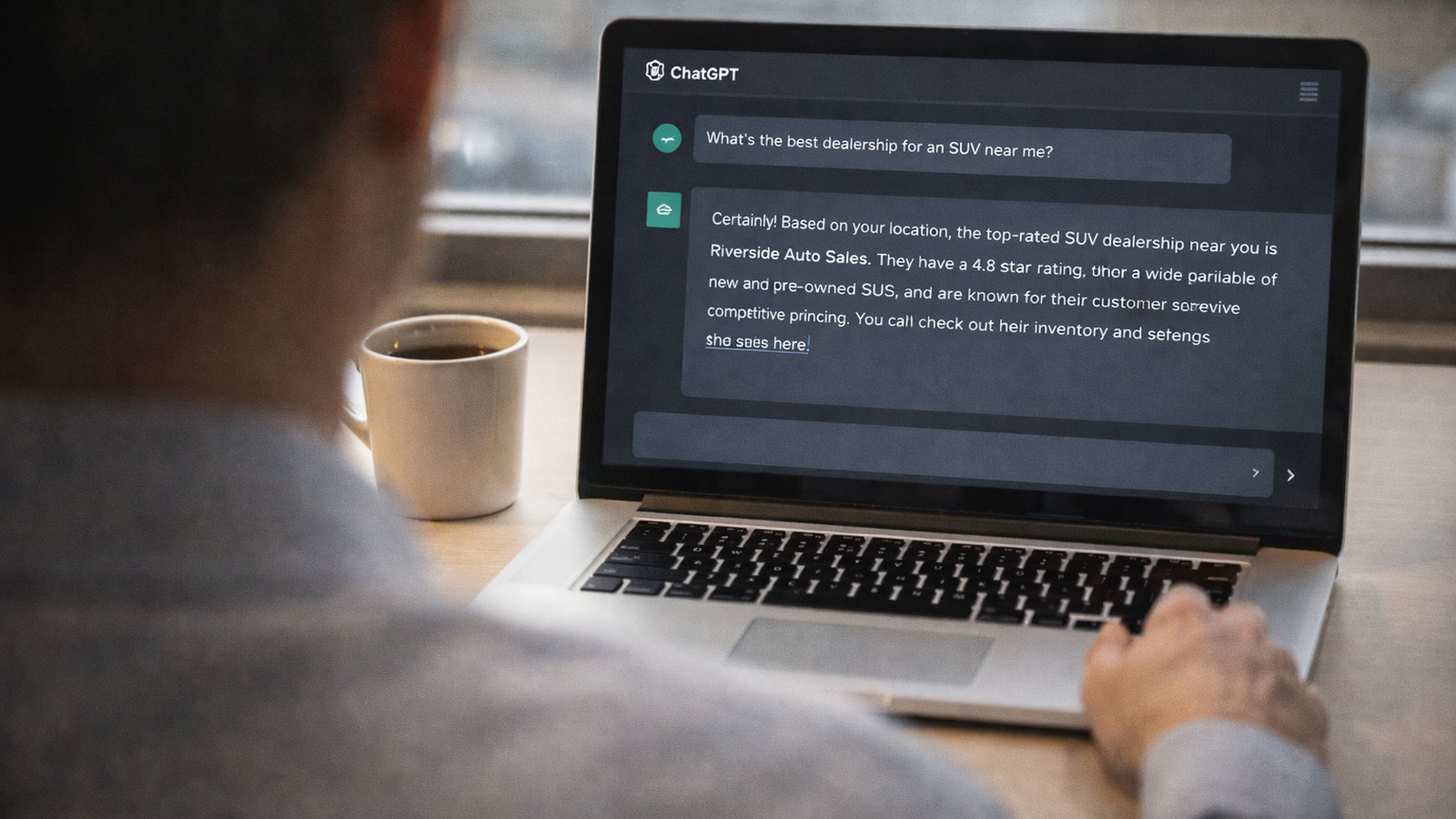
1. What Is GEO? A Direct Definition for Dealers
Generative Engine Optimization (GEO) is the practice of making your dealership's content visible to AI search engines -- ChatGPT, Google Gemini, Perplexity, Claude, and Grok -- so that when a consumer asks "What's the best Honda dealer near me?" or "Where can I find a 2026 RAV4 under $45,000?", your dealership shows up in the answer.
This is different from traditional SEO. With SEO, you optimize to rank on a list of ten blue links. With GEO, you optimize to be cited inside a synthesized answer that the AI generates. There is no page one. There is the answer -- and you are either part of it or you are not. The 15x growth in LLM-driven traffic makes this an urgent priority for every dealership.
Reunion Marketing puts it simply: "SEO got your dealership on Page 1. GEO gets your dealership into the answer."
2. Why Dealers Should Care: The 15x Traffic Number
In February 2026, Fullpath released its Auto Intelligence Index analyzing traffic patterns across thousands of dealership websites. The headline finding: total traffic from generative AI platforms grew more than 15x year-over-year in January 2026.
- ChatGPT accounts for roughly 89% of AI referral traffic to dealer websites. Google Gemini holds about 6.5% and is the fastest-growing platform.
- The 15x growth is off a small base -- but the trajectory is unmistakable.
- AI-driven visitors tend to arrive pre-informed and with narrower intent. When they click through, they are closer to a decision than a typical organic visitor.
Marchex research notes that 23% of U.S. adults had used ChatGPT by early 2024, with adoption tracking even higher among the 25-54 demographic -- the core vehicle-buying population. This shift is part of the broader 2026 market transformation reshaping how dealers compete.
3. How AI Search Finds Dealerships: The Mechanics
What AI does differently
Traditional search engines crawl your website, index your pages, and rank them. AI search engines do something fundamentally different. They:
- Crawl and ingest content from across the web -- your website, review platforms, directory listings, social profiles, and third-party inventory sites.
- Synthesize an answer by combining information from multiple sources into a single coherent response.
- Cite sources that contributed to the answer.
What AI search engines look for
According to research from Cars Commerce and CARVID, AI engines prioritize:
- Structured data (schema markup) that clearly identifies your business type, location, inventory, and services.
- Consistent NAP across all platforms.
- Review volume and sentiment from Google, Yelp, and other platforms.
- Content depth -- pages that provide direct, specific answers.
- Video content -- CBT News reports AI engines increasingly favor dealerships with video content.
Where AI pulls dealership data from
ChatGPT uses Bing Places data. Google Gemini pulls from Google Business Profile. Perplexity aggregates from multiple search engines and web sources.
4. Seven GEO Tactics for Dealership Websites
Tactic 1: Claim and optimize every business listing
- Google Business Profile -- complete every field.
- Bing Places -- this is ChatGPT's primary data source for local businesses. Many dealers ignore it.
- Apple Business Connect -- Siri and Apple Intelligence use this data.
- Yelp, Facebook, AutoTrader, Cars.com
Tactic 2: Implement automotive schema markup
- AutoDealer (LocalBusiness subtype)
- Vehicle -- make, model, year, price, mileage, condition, VIN
- Review/AggregateRating
- FAQPage
- Service -- with pricing where possible
Research from a GEO study found that schema markup enables AI engines to extract information with significantly higher accuracy. seoClarity research found schema markup can increase click-through rates by up to 30%.
Tactic 3: Write answer-first content
AI engines extract answers from content that leads with the answer. For every page, ask: "If a customer asked a question that this page should answer, can AI find the answer in the first two sentences?"
Tactic 4: Add statistics and specific claims
Adding quantitative data to content increased AI citation visibility by approximately 40%. Include specific inventory counts, review scores, and pricing where compliant.
Tactic 5: Build FAQ pages that mirror AI queries
People ask AI assistants questions in natural language. Your FAQ pages should match those patterns. Implement each Q&A pair with FAQPage schema markup.
Tactic 6: Invest in video content
Shoot a 60-90 second walkaround for every vehicle on your lot. Our video advertising guide covers the production details. Post it to YouTube with detailed descriptions. Embed it on the VDP page.
Tactic 7: Earn and manage reviews strategically
A dealership with 2,000 Google reviews and a 4.6 rating will be cited more confidently than one with 50 reviews and a 4.8 rating. Volume matters as much as score. Respond to every review -- AI systems analyze response patterns as a signal of engagement. This kind of brand building compounds over time.
5. Schema Markup for Automotive: A Practical Guide
| Schema Type | What It Does | Priority |
|---|---|---|
| AutoDealer | Identifies your business with location, contact, and service data | Critical |
| Vehicle | Structures individual vehicle listings | Critical |
| AggregateRating | Surfaces your review score and count | High |
| FAQPage | Makes Q&A content directly extractable | High |
| Service | Describes service offerings with pricing | Medium |
| Event | Structures sales events, test drive events | Medium |
| Offer | Structures specific deals and incentives | Medium |
Common mistakes
- Generic LocalBusiness instead of AutoDealer
- Missing inventory schema on VDP pages
- Stale data referencing sold vehicles or outdated hours
6. Content That Gets Cited by AI
| Content Feature | Visibility Boost | Why It Works |
|---|---|---|
| Inline citations and sources | +30-40% | AI engines prefer verifiable content |
| Quantitative statistics | +40% | Specific numbers are extractable and authoritative |
| Tables and structured formats | ~2.5x more citations | Easier for AI to parse and reformat |
| Improved fluency and readability | +15-30% | Clear writing is more likely to be paraphrased accurately |
| Expert quotations | +40% | Attributed quotes add authority |
Content types that work for dealerships
- Comparison pages. "2026 RAV4 vs. 2026 CR-V: Price, Features, and Fuel Economy Compared"
- Market condition pages. Updated monthly with current inventory and pricing.
- Buying guides. "How Much Does a Civic Cost in [City]? 2026 Pricing Guide"
- Service pricing pages. Specific, extractable pricing.
- EV buyer guides. Combining EVAP details with your inventory.
7. What to Do This Month
Week 1: Audit your foundation
- Check your Google Business Profile for completeness
- Claim and optimize your Bing Places listing
- Run your homepage and one VDP through Google's Rich Results Test
Week 2: Fix your structured data
- Confirm your website uses AutoDealer schema
- Verify VDP pages include Vehicle schema
- Add FAQPage schema to existing FAQ content
Week 3: Create GEO-optimized content
- Write three FAQ pages targeting natural-language queries
- Update your "About Us" page with specific, extractable facts
- Add a comparison page for your two best-selling models — your pillar models
Week 4: Start video and review campaigns
- Begin shooting 60-second vehicle walkaround videos
- Launch a structured review request process
- Post Google Business Profile updates with current offers