

The Short Answer
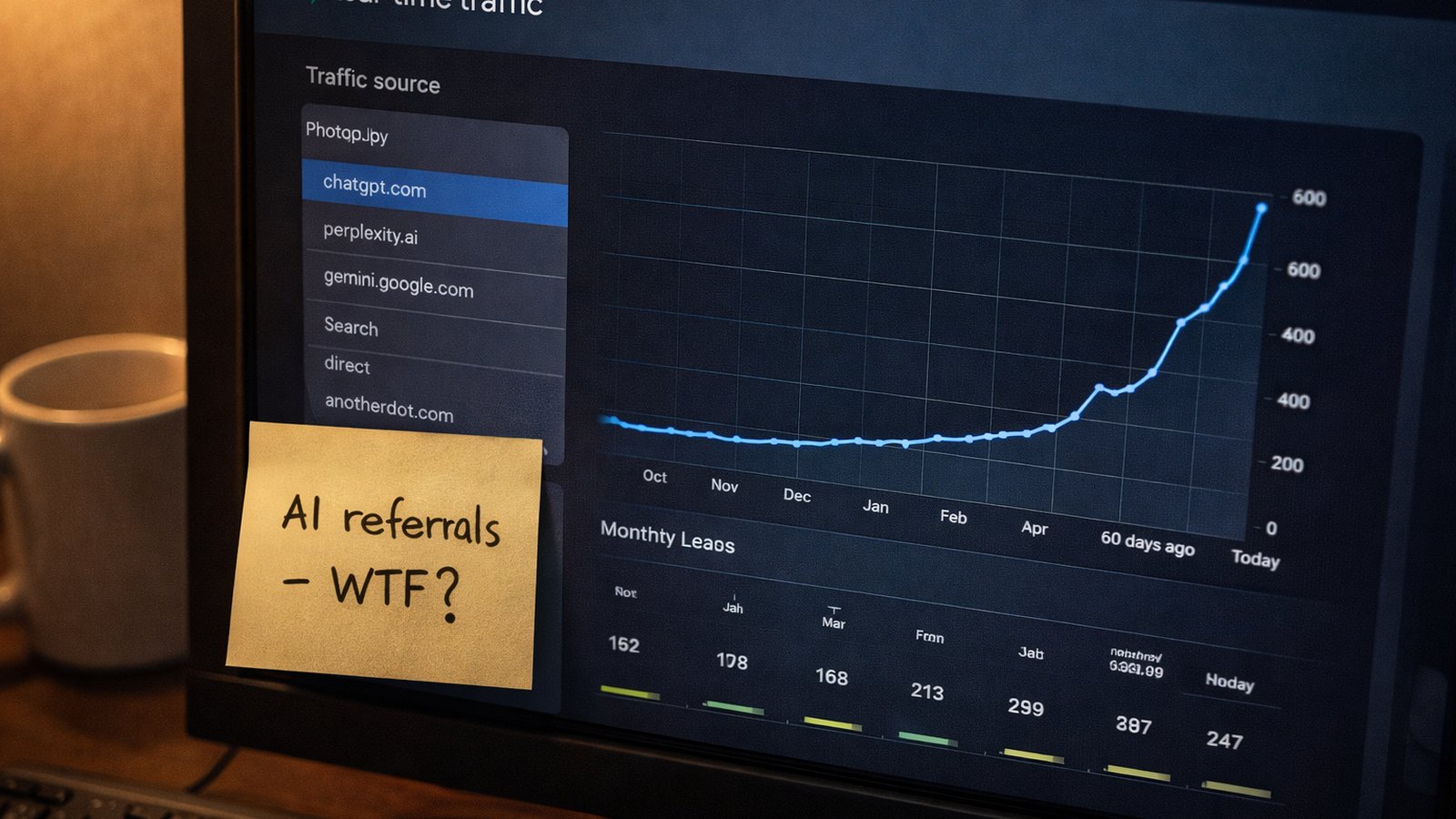
Traffic to dealer websites from AI platforms -- ChatGPT, Gemini, Perplexity, Claude, and Grok -- grew more than 15x year-over-year as of January 2026, according to Fullpath's Auto Intelligence Index (February 2026). ChatGPT alone accounts for approximately 89% of that AI-sourced traffic. Thirty percent of car buyers now use generative AI to research vehicles (Ekho, 2026), with 68.4% of those relying on ChatGPT specifically. If your site is not structured for AI crawlers, you are invisible to a growing share of your future customers. Our Generative Engine Optimization guide covers exactly how to fix this.
1. The 15x Number: What It Means
Platform Breakdown
| AI Platform | Share of AI Referral Traffic | Trend |
|---|---|---|
| ChatGPT (OpenAI) | ~89% | Dominant, stable |
| Google Gemini | ~6.5% | Fastest monthly growth (50%+ MoM) |
| Perplexity | Growing | Diversified citation sources |
| Claude (Anthropic) | Growing | Increasing share |
| Grok (xAI) | Small but growing | Early stage |
The 15x growth is on a small base -- AI referral traffic is still a fraction of total dealership website traffic compared to Google organic, Google Ads, and direct. Understanding how to measure the real ROI of emerging channels requires different thinking. But the trajectory matters more than the current volume. As Fullpath CEO Aharon Horwitz stated: "A 15x increase in AI referral traffic in a single year is not just a trend -- it signals a fundamental behavioral shift in how consumers begin their car-buying journey."
Context: The Broader AI Search Shift
Across all industries, AI platforms generated 1.13 billion referral visits in June 2025 -- a 357% increase from June 2024 (Position Digital, 2026). Meanwhile, Google's AI Overviews are reducing clicks on traditional organic results by an estimated 58%. For dealerships, the implication is clear: the next generation of car shoppers will not start on Google and click through to your website. They will start in ChatGPT or Gemini, ask "What is the best midsize SUV under $45K near Vancouver?" and either see your dealership cited -- or not. This is a seismic shift in the 2026 dealership landscape.
2. Where This Traffic Comes From
How AI Bots Crawl Dealer Sites
| Bot | Platform | Purpose |
|---|---|---|
| GPTBot | OpenAI / ChatGPT | Content indexing for AI responses |
| Google-Extended | Google Gemini | Training and AI response generation |
| PerplexityBot | Perplexity | Real-time search and citation |
| ClaudeBot | Anthropic / Claude | Content indexing |
| Applebot-Extended | Apple Intelligence | AI feature integration |
How Users Arrive from AI Platforms
AI referral traffic reaches your site through two paths:
- Direct citation links. When an AI platform cites your website in its response, the user can click through to your page. This appears in Google Analytics as referral traffic from chatgpt.com, gemini.google.com, etc.
- Informed navigation. The user reads an AI-generated response that mentions your dealership, then searches for you by name or navigates directly. This appears as direct or branded search traffic -- harder to attribute, but still AI-influenced.
What AI Users Look Like
The Ekho 2026 AI Vehicle Research Study found that AI-using car shoppers arrive at dealership websites with distinct characteristics:
- Pre-informed. They have already researched models, pricing, and options through AI. They arrive with narrower intent and more specific questions.
- Higher conversion potential. Because they have done more research before visiting, they are closer to a purchase decision.
- Less tolerant of missing information. If your VDP lacks the specs, photos, or pricing that the AI summary referenced, the user bounces immediately.
3. What AI Bots See When They Visit Your Site
What AI Bots Can Read
- Text content -- headings, paragraphs, lists, tables
- Structured data -- JSON-LD schema markup (Vehicle, FAQ, LocalBusiness, etc.)
- Meta descriptions and title tags
- Alt text on images (bots cannot "see" images -- they read the alt text)
- Internal link structure -- how pages connect to each other
- robots.txt and llms.txt -- instructions on what to crawl and what your site is about
What AI Bots Cannot Read
- JavaScript-rendered content -- many dealer platforms render inventory dynamically via JavaScript
- Content behind login walls or forms
- Images and video (without proper alt text and structured data)
- PDF documents (unless specifically crawled, which most bots skip)
- Content in iframes from third-party providers
The Dealership-Specific Problem
Most dealership websites are built on third-party platforms (Dealer.com, DealerOn, Dealer Inspire, etc.) — part of the fragmented dealership software stack — that use heavy JavaScript rendering for inventory pages. A VDP that shows a human visitor 30 photos, full specs, pricing, and a payment calculator may show an AI bot nothing more than a loading spinner and a page title. This means your best content -- your actual inventory -- may be invisible to the AI platforms generating 15x more traffic.
4. Is Your Site AI-Ready? A 12-Point Checklist
| # | Item | Status |
|---|---|---|
| 1 | robots.txt allows AI crawlers (GPTBot, PerplexityBot, ClaudeBot not blocked) | Yes / No |
| 2 | llms.txt file exists at yourdomain.com/llms.txt with site description and key pages | Yes / No |
| 3 | VDP content renders in HTML (not JavaScript-only) | Yes / No |
| 4 | JSON-LD schema on VDPs (Vehicle or Product schema with make, model, year, price) | Yes / No |
| 5 | JSON-LD schema on homepage (LocalBusiness with name, address, hours, phone) | Yes / No |
| 6 | FAQ schema on relevant pages (service pages, financing pages, about page) | Yes / No |
| 7 | Unique meta descriptions on every key page | Yes / No |
| 8 | Alt text on all vehicle images (descriptive, not "image1.jpg") | Yes / No |
| 9 | Inventory data in page content (specs, features, pricing in readable text) | Yes / No |
| 10 | Internal linking structure connects VDPs to model pages, model pages to homepage | Yes / No |
| 11 | Content freshness -- blog/insights page updated within last 90 days | Yes / No |
| 12 | Page load speed under 3 seconds on mobile | Yes / No |
Scoring: 10-12: Well-positioned. 7-9: Solid foundation with gaps. 4-6: Significant blind spots. 0-3: Functionally invisible to AI search platforms.
5. robots.txt and llms.txt: The Two Files That Control AI Access
robots.txt
Your robots.txt file tells crawlers what they can and cannot access. Many dealership website platforms ship with restrictive configurations that block AI crawlers by default.
# ALLOW AI crawlers (add these if missing)
User-agent: GPTBot
Allow: /

User-agent: PerplexityBot
Allow: /

User-agent: ClaudeBot
Allow: /

User-agent: Google-Extended
Allow: /

User-agent: Applebot-Extended
Allow: /
If your robots.txt contains Disallow: / for any of these user agents, AI bots are being told not to crawl your site. This is the single most common reason dealership content does not appear in AI-generated responses.
llms.txt
The llms.txt file is a newer standard, proposed by Jeremy Howard in late 2024, that specifically tells AI systems what your site is about and which pages matter most.
# [Dealership Name]

> [Dealership Name] is an authorized [Brand] dealer in [City, State/Province],
> offering new and pre-owned vehicles, financing, and certified service.

## Inventory

- [New Vehicles](/new-inventory): Browse our current new [Brand] inventory
- [Pre-Owned Vehicles](/used-inventory): Certified and inspected pre-owned vehicles
- [Specials](/specials): Current offers and incentive programs

## Services

- [Service Department](/service): Factory-trained technicians, online scheduling
- [Parts Department](/parts): OEM parts, accessories, and online ordering
- [Financing](/finance): Credit applications, payment calculators, lease options

## About

- [About Us](/about): Our history, team, and community involvement
- [Reviews](/reviews): Customer testimonials and ratings
- [Contact](/contact): Hours, directions, and phone numbers
Place this file at yourdomain.com/llms.txt. It takes five minutes to create and gives AI systems a structured overview of your dealership.
6. Structured Data for AI: What Schema to Implement
| Schema Type | Where to Implement | Why It Matters for AI |
|---|---|---|
| LocalBusiness (or AutoDealer) | Homepage | Tells AI your name, address, hours, phone, service area |
| Vehicle (or Product) | Every VDP | Gives AI make, model, year, price, mileage, condition |
| FAQPage | Service, finance, about pages | AI platforms heavily cite FAQ content |
| Review / AggregateRating | Reviews page, homepage | Feeds AI reputation data for recommendations |
| BreadcrumbList | All pages | Helps AI understand site hierarchy |
| Organization | Homepage, about page | Establishes entity identity for knowledge graph |
7. What to Do This Month: A 30-Day Action Plan
Week 1: Audit
- Check your robots.txt for AI crawler blocks (takes 2 minutes)
- Run Google's Rich Results Test on your homepage and 3 VDPs
- View Page Source on a VDP -- is inventory data in the HTML?
- Check Google Analytics for existing AI referral traffic
Week 2: Quick Wins
- Update robots.txt to allow GPTBot, PerplexityBot, ClaudeBot, Google-Extended
- Create and publish an llms.txt file at your domain root
- Add or update LocalBusiness schema on your homepage
- Write unique meta descriptions for your top 10 pages
Week 3: Content
- Add FAQ sections to your service page, finance page, and about page
- Implement FAQPage schema on those FAQ sections
- Audit alt text on vehicle images -- replace generic filenames with descriptive text
- Publish a fresh blog post or insights article
Week 4: Verify and Monitor
- Re-run the 12-point checklist from Section 4
- Set up a GA4 custom report for AI referral traffic sources
- Test your dealership in ChatGPT, Gemini, and Perplexity
- Document your baseline AI referral traffic numbers
8. The Bigger Picture: Why This Matters Now
The 15x number is from January 2026. By January 2027, it will likely be multiples higher. The dealerships that prepare now -- by opening their sites to AI crawlers, implementing structured data, creating AI-readable content, and monitoring AI referral traffic -- will compound an advantage that late movers cannot easily replicate.
This is analogous to the early days of Google SEO: the dealers who invested in 2005-2010 built search equity that still pays dividends. The same compounding logic applies to performance advertising — early movers build advantages that compound. The AI search equivalent is happening right now. The cost of preparation is low -- most actions in this guide require hours, not weeks, of technical work. The cost of inaction is invisibility to an increasing share of your future customers.