

The Short Answer
Video advertising now captures 35% of all digital ad budgets globally, with total video ad spend reaching $236 billion in 2026 (IAB, 2025 Digital Video Ad Spend Report). For dealerships, video is no longer optional -- it is the format that stops the scroll, builds trust before the showroom visit, and drives measurable appointment volume. Sub-60-second video ads achieve a 71.3% average completion rate (Amra & Elma, 2026). Meanwhile, 94.7% of marketers report positive ROI from video, with an average return of 6.2x investment across industries (Lemonlight, 2026).
1. Why Video Dominates Dealership Marketing
The shift to video is not a trend. It is a structural change in how consumers process information and how platforms distribute content.
The Numbers That Matter for Dealers
| Metric | Data Point | Source |
|---|---|---|
| Share of digital ad budgets | 35% allocated to video | IAB, 2025 |
| Global video ad spend | $236 billion in 2026 | IAB, 2025 |
| Marketer-reported positive ROI | 94.7% | Lemonlight, 2026 |
| Average video ROI | 6.2x investment | Lemonlight, 2026 |
| Sub-60-second ad completion rate | 71.3% | Amra & Elma, 2026 |
| 45-59 second ad completion rate | 74.8% (highest bracket) | Amra & Elma, 2026 |
| CTV ad completion rates | 95%+ | Amra & Elma, 2026 |
For a dealership GM, the critical insight is this: video is the format most likely to hold attention long enough to deliver a message. A well-produced video commands 15-60 seconds of focused attention -- enough time to show inventory, communicate a value proposition, and drive an action. It is a cornerstone of any full-funnel advertising strategy.
Why Most Dealership Video Fails
Despite the data, most dealership video underperforms — often because dealers rely on generic OEM templates instead of original content. The reasons are consistent:
- Stock footage over real inventory -- Customers recognize stock footage instantly. It signals "this dealership does not care enough to show me what they actually have."
- No hook in the first 3 seconds -- Social media users decide whether to watch or scroll within 1.5-3 seconds. Most dealer videos open with a logo animation or a wide shot of the lot.
- Talking-head monologues -- The GM standing in the showroom talking for 90 seconds is the default dealership video format. It is also the least engaging format on every platform.
- No call to action -- A video that ends without telling the viewer what to do next is brand awareness at best and wasted spend at worst.
- One video for every platform -- A vertical 9:16 video optimized for TikTok will underperform as a horizontal 16:9 pre-roll on YouTube.
2. Video Formats That Work for Dealers
Not all video is created equal. Different formats serve different objectives in the sales funnel.
Top-of-Funnel: Awareness and Reach
| Format | Length | Purpose | Best Platform |
|---|---|---|---|
| Inventory walkaround | 15-30 sec | Showcase specific units | Meta Reels, TikTok |
| Dealership brand story | 30-60 sec | Establish identity and trust | YouTube, Meta |
| Customer delivery moment | 10-20 sec | Social proof | Instagram Reels, TikTok |
| Event/community highlight | 15-45 sec | Local presence | Meta, Instagram Stories |
Mid-Funnel: Consideration and Engagement
| Format | Length | Purpose | Best Platform |
|---|---|---|---|
| Vehicle comparison | 60-120 sec | Help decision-making | YouTube |
| Feature deep-dive | 30-60 sec | Educate in-market shoppers | YouTube, Meta |
| Service department tour | 30-45 sec | Build service trust | Meta, Instagram |
| Finance explainer | 30-60 sec | Reduce purchase anxiety | YouTube, Meta |
Bottom-of-Funnel: Conversion
| Format | Length | Purpose | Best Platform |
|---|---|---|---|
| Limited-time offer | 10-15 sec | Drive urgency | Meta, YouTube bumper |
| Testimonial / review clip | 15-30 sec | Final social proof | Meta, Google Demand Gen |
| "Book your test drive" CTA | 6-15 sec | Direct response | YouTube bumper, Meta |
3. Short-Form vs. Long-Form: When to Use Each
Short-Form (Under 60 Seconds)
Best for: Awareness, inventory showcasing, social proof, and retargeting.
Short-form dominates attention metrics. The 45-59 second window achieves the highest completion rate at 74.8% (Amra & Elma, 2026). For paid advertising on Meta and TikTok, 15-30 seconds is the optimal range.
Long-Form (60 Seconds to 5 Minutes)
Best for: Education, brand building, YouTube search, and high-intent audiences.
Long-form video is underutilized by dealerships, but it serves a critical function: it captures high-intent shoppers who are actively researching. A three-minute comparison video between a 2026 Honda CR-V and a 2026 Toyota RAV4 will not go viral, but it will attract viewers who are 30-60 days from a purchase decision.
The Right Mix
For most dealerships, the optimal allocation is roughly 70% short-form, 30% long-form. Short-form drives volume and awareness. Long-form captures intent and builds lasting search equity. Concentrate video production on your pillar models for maximum impact.
4. Production: In-House vs. Agency
Cost Comparison
| Factor | In-House Production | Agency Production |
|---|---|---|
| Annual cost (full team) | $180,000-$350,000 salary + benefits + equipment | $48,000-$120,000 depending on volume |
| Cost per video (high volume, 100+/month) | $8-$12 in labor per video | $75-$150 per video |
| Startup equipment cost | $5,000-$40,000 first year | $0 (agency's equipment) |
| Ramp-up time | 2-3 months to build workflow | Immediate (existing team) |
| Creative range | Limited to in-house skill set | Access to editors, designers, motion graphics |
| Turnaround time | Same-day possible | 3-10 business days typical |
The Hybrid Model in Practice
| Content Type | Production Source | Frequency |
|---|---|---|
| Inventory walkarounds | In-house (smartphone + gimbal) | Daily |
| Customer delivery moments | In-house (smartphone) | As they happen |
| Brand campaign video | Agency | Quarterly |
| Paid social ad creative | Agency | Monthly refresh |
| YouTube long-form content | Agency (or hybrid) | 2-4x per month |
| Event / community coverage | In-house with agency editing | As needed |
5. Platform-Specific Best Practices
Meta (Facebook + Instagram)
Specs: 9:16 vertical (Reels, Stories), 1:1 square (Feed), 16:9 horizontal (in-stream). Maximum file size 4GB. Recommended resolution 1080x1920 for vertical.
What works for dealers on Meta:
- Hook in the first 1.5 seconds. Meta's algorithm evaluates early engagement signals. If viewers scroll past, the algorithm stops distributing.
- Sound-optional design. 85% of Meta video is watched without sound initially. Use text overlays, captions, and visual storytelling that works on mute.
- Inventory-specific creative. A video ad for a specific 2026 Honda Civic should target in-market Honda shoppers within a 30-mile radius.
- Reels format for organic reach. Dealerships posting 3-5 Reels per week see significantly more organic distribution than those posting static images.
Benchmarks: Meta video ads average $14.91 CPM. Click-through rates for automotive video ads average 0.80-1.20% (Addict Mobile, 2026).
YouTube
What works for dealers on YouTube:
- YouTube is a search engine. Title, description, and tags matter as much as the video itself.
- Longer watch time wins. YouTube's algorithm rewards total watch time, not completion rate.
- Pre-roll and bumper ads for local targeting. YouTube allows geographic targeting down to the zip code level.
- YouTube Shorts for discoverability. Shorts reach a younger demographic and feed into YouTube's recommendation algorithm.
TikTok
What works for dealers on TikTok:
- Authenticity over production value. TikTok's audience actively rejects polished, corporate-looking content.
- Trend participation. TikTok's algorithm rewards content that uses trending sounds, formats, and hashtags.
- The algorithm prioritizes retention. TikTok favors videos that keep 80%+ of viewers engaged, regardless of follower count (WebFX, 2026).
- Inventory ads at scale. TikTok's Automotive Ads for Inventory product allows dealers to automatically generate video ads from their inventory feed (Fluency, 2026).
Benchmarks: TikTok ads average $9.16 CPM -- roughly 38% lower than Meta's average (Addict Mobile, 2026).
Platform Comparison Summary
| Factor | Meta | YouTube | TikTok |
|---|---|---|---|
| Primary format | 9:16 vertical | 16:9 horizontal + Shorts | 9:16 vertical |
| Optimal ad length | 15-30 sec | 15 sec (pre-roll) / 2-5 min (organic) | 15-30 sec |
| CPM benchmark | $14.91 | $10-$30 (non-skip) | $9.16 |
| Audience age | 25-54 (broadest) | 25-65 (search-intent) | 18-34 (skewing older) |
| Best dealer use | Inventory targeting, retargeting | Search visibility, long-form | Awareness, younger buyers |
| Sound dependency | Low (sound-off default) | High (sound-on default) | High (sound-on default) |
6. Measuring Video ROI: Units, Not Views
The biggest mistake dealerships make with video is measuring the wrong things. Views, impressions, and completion rates are distribution metrics. They do not tell you whether the content moved metal.
The Metrics That Matter
| Metric | What It Tells You | How to Track |
|---|---|---|
| Video-influenced appointments | Did video drive showroom traffic? | UTM-tagged landing pages, call tracking |
| Cost per appointment (from video) | Is video efficient vs. other formats? | Platform conversion tracking + CRM match |
| View-to-lead rate | What percentage of viewers become leads? | Platform pixel + form submission tracking |
| Video-sourced units sold | Did video campaigns contribute to closed deals? | CRM source attribution, last-touch analysis |
| Cost per sale (video channel) | What does video cost per unit moved? | Total video spend / video-attributed units |
| Creative fatigue signal | When does performance start declining? | CTR drop >20% over 14-day rolling average |
Setting Up Attribution
Video attribution requires three components working together — the same principles we cover in measuring real marketing ROI:
- UTM parameters on every video CTA. Every link in a video description, every landing page URL in an ad, and every QR code in a video should carry UTM tags.
- Call tracking with source attribution. A significant percentage of video viewers will call instead of clicking. Without call tracking numbers assigned to video campaigns, you lose visibility.
- CRM integration. The lead source in your CRM should trace back to the video campaign.
7. The Equipment Question
Starter Kit ($500 or Less)
| Item | Cost | Purpose |
|---|---|---|
| Smartphone (existing) | $0 | Camera -- any phone from the last 3-4 years |
| Smartphone gimbal (DJI OM 7 or similar) | $100-$160 | Stabilization -- eliminates shaky footage |
| Wireless lavalier mic (Rode Wireless ME) | $100-$150 | Audio -- clear voice audio is the single biggest quality upgrade |
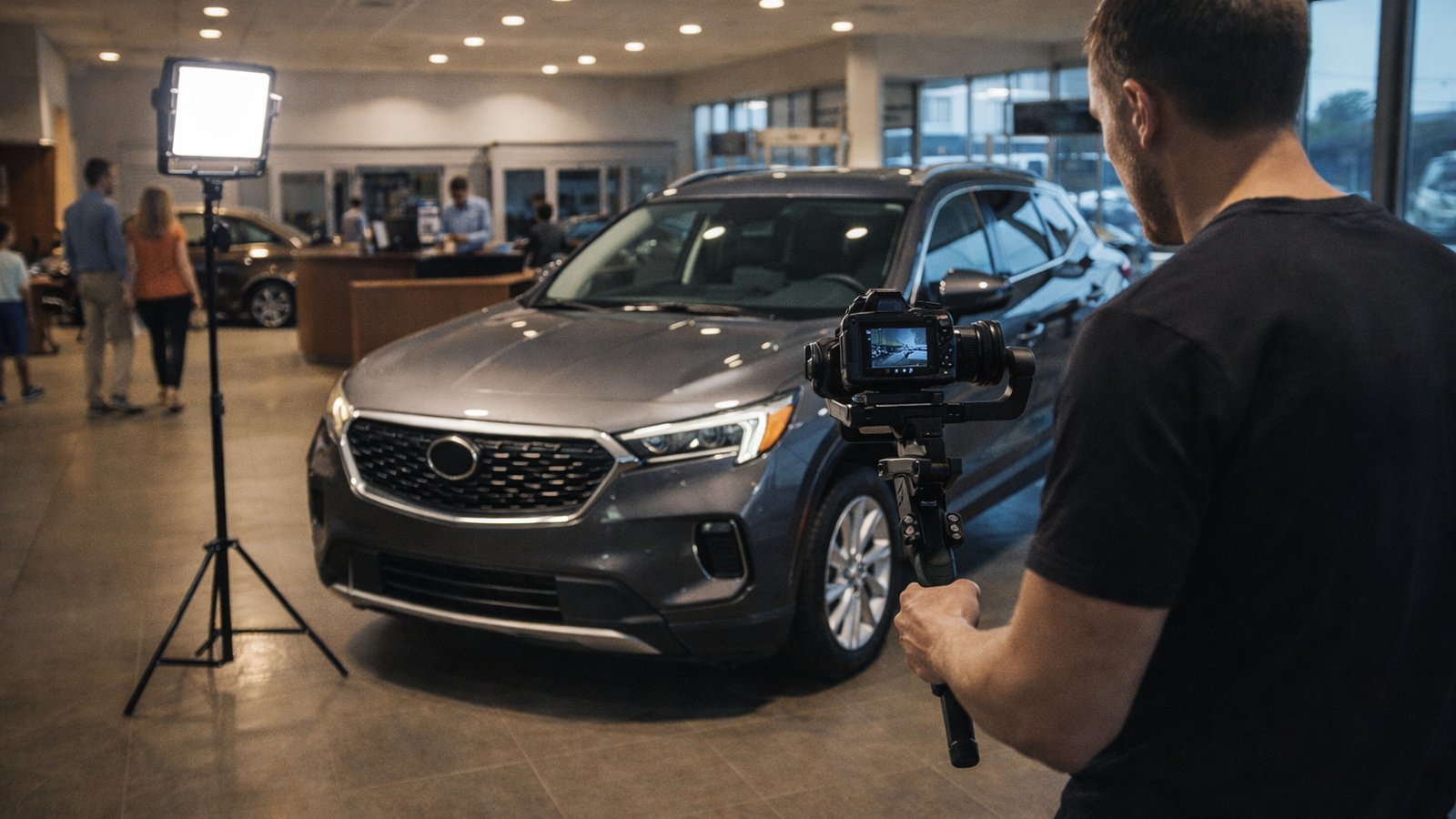
| Portable LED light panel | $50-$100 | Lighting -- showroom lighting is often harsh |
| Basic tripod with phone mount | $30-$50 | Stability for stationary shots |
Professional Kit ($5,000-$15,000)
| Item | Cost | Purpose |
|---|---|---|
| Mirrorless camera (Sony A7 IV or Canon R6 II) | $2,000-$2,500 | Higher dynamic range, shallow depth of field |
| 24-70mm f/2.8 zoom lens | $1,000-$1,800 | Versatile focal range |
| Professional gimbal (DJI RS 4) | $400-$550 | Smooth tracking shots around vehicles |
| 2-light LED kit (Aputure or Nanlite) | $500-$1,500 | Professional lighting |
| Wireless mic system (Rode Wireless Pro) | $300-$400 | Broadcast-quality audio |
| Editing software (DaVinci Resolve) | $0-$295 | Industry-standard editing |
Start with the starter kit. Upgrade based on results, not aspirations. Our creative team handles production for dealers who want to skip the learning curve.
8. AI-Generated Video: The Emerging Option
The video production landscape is shifting with AI video generation tools (Sora, Runway, Pika, Creatify) entering the market. For dealerships, the current state is:
- AI-generated generic content (animated text, background visuals, promotional graphics) is production-ready and cost-effective.
- AI-generated vehicle footage is not yet convincing enough to replace real walkaround videos. AI hallucinations on vehicle details destroy credibility.
- AI-assisted editing (automated captioning, background removal, format conversion) is production-ready and saves significant time.
The practical recommendation: use AI tools for editing and variant generation, not for replacing authentic vehicle and dealership footage.
9. Common Mistakes and How to Avoid Them
| Mistake | Why It Happens | What to Do Instead |
|---|---|---|
| Logo intro longer than 3 seconds | Agency habit from broadcast TV era | Hook with visual content first, logo at end |
| Filming in landscape for TikTok/Reels | Default camera orientation | Shoot 9:16 vertical for social, 16:9 for YouTube |
| No captions or text overlays | Assumed sound-on viewing | Add captions to every social video |
| Same video on every platform | Efficiency shortcut | Shoot once, edit platform-specific versions |
| Monthly creative refresh | "Set it and forget it" mentality | Refresh paid creative every 30-60 days minimum |
| Measuring views instead of appointments | Easy metric to report | Build attribution from video to CRM lead source |
| Ignoring YouTube entirely | Perceived as entertainment-only | YouTube is a search engine -- rank for model reviews |