

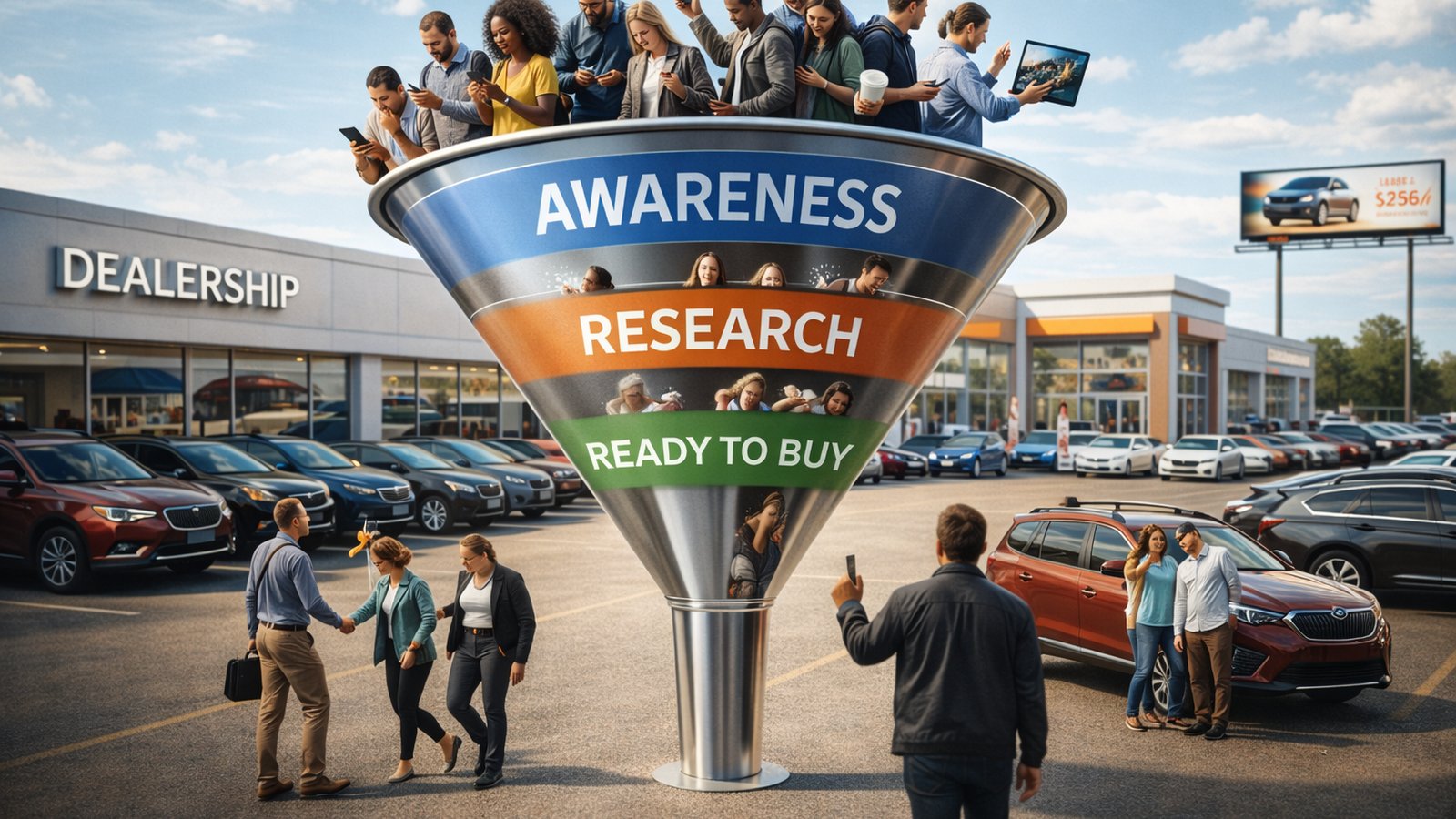
1. What Full-Funnel Actually Means for a Dealership
A full-funnel advertising strategy means running coordinated campaigns across every stage of the buyer's journey — awareness, consideration, and conversion — so that no matter where a shopper is in their 13.5-hour online research process (Cox Automotive, 2024), your dealership is present. The average car buyer visits 4.2 websites during their purchase journey (Google, 2024), and 86% conduct online research before ever visiting a showroom (Autotrader, 2024). If your ads only show up when someone is already searching for "2026 Honda CR-V near me," you have ceded every previous touchpoint to your competition. The Three Pillar Model provides the framework for concentrating spend on the models that actually move. You are paying to compete at the moment of decision while your competitor has been building trust for weeks.
Full-funnel is not about spending more — a point we explore in The $20K Question. It is about deploying spend at every stage so the shopper who sees your brand awareness video on Instagram in week one recognizes your Vehicle Listing Ad on Google in week three — and clicks yours instead of the competitor's. Dealers running coordinated full-funnel strategies see 30-40% higher conversion rates at the bottom of the funnel because the prospect arrives with existing trust and brand recognition (Nielsen, 2023).
This article breaks down the three stages, the platforms that own each stage, the budget math that makes it work, and the mistakes that waste money when channels run in silos.
2. Top of Funnel: Meta Awareness (Video, Lead Forms, Catalog)
Why Meta Owns the Top
The top of the funnel is about reach and recognition. You are not selling a car here. You are establishing that your dealership exists, that it is active, and that it has something worth paying attention to. Meta (Facebook and Instagram) is the dominant platform for top-of-funnel automotive advertising for three reasons:
- Scale. Meta reaches 3.07 billion monthly active users globally (Meta Earnings Report, Q4 2025). In any given local market, your target audience is on the platform daily.
- Visual formats. Video ads, Reels, and carousel formats are designed for attention and storytelling — the currency of awareness.
- Cost efficiency. Automotive has the lowest absolute CPM on Meta at $10.01 (WordStream, 2025), making it the most affordable platform for broad reach in the auto vertical.
Top-of-Funnel Campaign Types
| Campaign Type | Format | Objective | Benchmark |
|---|---|---|---|
| Brand Video | 15-30s Reels/Stories | Video Views, Reach | $0.01-$0.03 per view |
| Inventory Showcase | Carousel or Collection | Traffic, Engagement | 2-4% CTR |
| Event/Sale Promotion | Static + Video | Reach, Local Awareness | $5-$10 CPM |
| Lead Forms (Soft) | Instant Form | Lead Generation | 50% lower CPL vs. landing pages |
The Lead Form Advantage
Meta Instant Forms reduce cost per lead by 20-50% compared to landing page conversions (Meta Business, 2025). The native form experience eliminates page load friction and pre-fills user data, which dramatically improves conversion rates. Rusnak Auto Group saw 44% more leads and 29% lower cost per lead when using Meta's Advantage+ audience targeting (Meta Case Study, 2025).
Automotive Inventory Ads at the Top
Meta's Automotive Inventory Ads (AIA) are catalog-based ads that dynamically display your vehicles to in-market shoppers. While they perform across the funnel, at the top they serve a discovery function — putting specific vehicles in front of shoppers who have shown interest in similar makes and models but have not yet visited your website. Facebook's On-Facebook Destination ads reduced cost per lead by 82% compared to website destination ads (Meta, 2024).
What Good Looks Like
A dealership spending $3,000-$5,000 per month on Meta top-of-funnel should see:
- 200,000-500,000 impressions per month in their local market
- Video view rates of 15-25% (ThruPlay)
- A measurable lift in branded search volume on Google within 60-90 days
That last metric is the signal that top-of-funnel is working. When more people Google your dealership name, your awareness investment is paying off.
3. Middle of Funnel: Google Search + Vehicle Listing Ads
Why Google Owns the Middle
When a shopper moves from "I might need a new car" to "I am comparing specific models and dealers," they go to Google. This is the consideration stage — the middle of the funnel — and Google Search is the dominant platform.
Automotive search ads deliver a CPC of $2.41, a CTR of 8.29%, and a conversion rate of 7.76% (WordStream Automotive Benchmarks, April 2024-March 2025). These are strong numbers relative to other industries, and they reflect the high intent of automotive search queries.
Campaign Types That Win the Middle
1. Branded Search
Campaigns targeting your dealership name and variations. These should run 24/7 and will deliver your highest conversion rates (15-25% CTR, 10-20% CVR). Yes, you "should" rank organically for your own name. But competitors bid on your name, and branded search ads cost pennies per click while protecting your traffic.
2. Non-Branded Search
Campaigns targeting category terms: "Honda dealer near me," "used SUV under $30,000," "best lease deals April 2026." These carry higher CPCs ($3-$8) but capture shoppers actively in-market who have not yet chosen a dealer.
3. Vehicle Listing Ads (VLAs)
Google's Vehicle Listing Ads are the automotive equivalent of Shopping ads. They display specific vehicles from your inventory — with photos, pricing, mileage, and a link to your VDP — directly in search results. VLAs deliver:
- Cost per lead between $25 and $45 (DealerSmart, 2026)
- Conversion rates of 8-12%, with top performers hitting 15-20% (Demand Local, 2025)
- CPC up to 67% lower than standard search ads (WillowWood Ventures, 2026)
VLAs are now table stakes for any dealership with a properly maintained inventory feed. If your competitor's specific vehicles are showing in Google results and yours are not, you are losing clicks at the highest-intent moment.
The Google Search Budget Framework
| Campaign Type | % of Google Budget | Target CPA | Expected CVR |
|---|---|---|---|
| Branded Search | 10-15% | $5-$15 | 15-25% |
| Non-Branded Search | 30-40% | $35-$90 | 5-8% |
| Vehicle Listing Ads | 25-35% | $25-$45 | 8-15% |
| Performance Max (see below) | 20-30% | $50-$120 | 8-18% |
4. Bottom of Funnel: Performance Max — AI-Driven Conversion
What Performance Max Actually Does
Performance Max (PMax) is Google's AI-driven campaign type that serves ads across every Google surface — Search, Display, YouTube, Gmail, Discover, Maps, and Shopping — from a single campaign. You provide creative assets (up to 15 headlines, 5 descriptions, 20 images, and 5 videos), audience signals, and conversion goals. Google's machine learning then evaluates over 3,800 auction-time signals in 100 milliseconds — including device, location, time of day, audience behavior, search context, and weather — to determine the optimal bid, placement, and creative combination for each impression (Google Ads Blog, 2026).
For automotive dealers, PMax integrates directly with your vehicle feed, enabling Vehicle Ads that show specific inventory across Google's entire network.
Why PMax Sits at the Bottom
PMax excels at conversion because it optimizes for outcomes, not placements. While you can (and should) use PMax across the funnel, its primary value for dealers is closing the loop:
- A shopper who saw your Meta awareness video and later searched on Google may encounter your PMax ad on YouTube, in Gmail, or on a Display placement — reinforcing the brand they already recognize.
- PMax's AI identifies which combination of signals predicts conversion and concentrates spend there.
- Performance Max now drives 62% of all Google ad clicks and 45% of Google Ads conversions (Google Ads Blog, February 2026).
Automotive PMax Benchmarks
| Metric | Average | Top 10% |
|---|---|---|
| CPA | $50-$120 | Under $50 |
| CVR (from landing page) | 8-18% | 18%+ |
| CTR | 2.50% | 4%+ |
| CPC | $0.20 | Under $0.15 |
| Cost Per Sale (with offline import) | $250-$800 | Under $250 |
Source: DealerSmart Automotive Benchmarks, 2026; Demand Local, 2025
The Critical Setup: Offline Conversion Import
PMax optimizes toward whatever conversion you tell it matters. If you only track form fills and phone calls, PMax will find you more form fills and phone calls — regardless of whether those leads buy cars. The dealers who get the best results from PMax import offline sales data from their CRM back into Google Ads, so the algorithm learns which leads actually purchased and optimizes toward that outcome.
Without offline conversion import, your PMax campaign is flying blind. With it, Google's algorithm learns the profile of a buyer — not just a lead — and adjusts bidding accordingly. Dealerships that implemented offline conversion import saw cost per sale drop by 25-40% within 90 days (Google Automotive Vertical Insights, 2025).
5. Budget Split Recommendations
The question every GM asks: "How do I split my budget between Google and Meta?"
There is no universal answer, but there are frameworks grounded in data.
The Binet & Field Baseline
Les Binet and Peter Field's landmark research on advertising effectiveness, published through the Institute of Practitioners in Advertising (IPA), established the 60/40 framework: 60% of budget toward brand building (upper funnel) and 40% toward activation (lower funnel) (Binet & Field, "The Long and the Short of It," IPA, 2013). For dealerships, this translates to:
Recommended Budget Framework for Dealerships
| Funnel Stage | Platform | % of Total Budget | Monthly Spend ($15K Total) |
|---|---|---|---|
| Top (Awareness) | Meta Video, Reels, AIA | 25-30% | $3,750-$4,500 |
| Middle (Consideration) | Google Search, VLAs | 35-40% | $5,250-$6,000 |
| Bottom (Conversion) | Google PMax, Meta Retargeting | 25-30% | $3,750-$4,500 |
| Retention/Conquest | Meta Custom Audiences, Google RLSA | 5-10% | $750-$1,500 |
Adjustments by Dealership Type
New franchise, single point: Weight heavier toward Meta awareness (35% top) because brand recognition in the local market is the growth lever. Google captures existing demand; Meta creates new demand.
Established multi-rooftop group: Weight heavier toward Google conversion (40% bottom) because the brand is already known. The priority is capturing and converting the demand that exists.
Used vehicle focus: Weight heavier toward VLAs and FBMP (see Article 15) because used vehicle shoppers search by specific vehicle attributes, not dealer brand.
6. How the Channels Work Together
The power of full-funnel is not in any single channel. It is in the compounding effect when they work as a system.
The Attribution Chain
Here is what a typical full-funnel buyer journey looks like:
- Day 1: Shopper sees your 15-second Instagram Reel showcasing new inventory arrivals. Does not click. Does not engage. But your dealership name is now stored in memory.
- Day 8: Same shopper searches "best SUV lease deals" on Google. Your non-branded search ad appears. They click, browse your inventory page, leave without converting. Google records the session.
- Day 12: A PMax ad for a specific vehicle from your lot appears in the shopper's Gmail inbox. They click through to the VDP. Still not ready.
- Day 15: Shopper searches your dealership name on Google. Your branded search ad appears at the top. They click, submit a lead form, and book a test drive.
- Day 18: They buy the car.
In a last-click attribution model, branded search gets 100% of the credit. In reality, every touchpoint contributed. Cox Automotive's attribution research found that Autotrader influenced 55% of sales under multi-touch attribution versus just 21% under last-touch — demonstrating how single-touch models dramatically undervalue upper-funnel channels (Cox Automotive, 2023).
The Branded Search Lift Test
The simplest way to measure whether your Meta awareness spend is working: track branded search volume in Google Search Console before and after launching top-of-funnel campaigns. A 15-25% lift in branded search queries within 60-90 days is a strong signal that awareness investment is converting to consideration.
Cross-Platform Retargeting
The connective tissue between channels is retargeting:
- Meta to Google: Build custom audiences in Meta from your website visitors (via Pixel). Run retargeting ads on Meta to people who visited your site via Google.
- Google to Meta: Use Google's Remarketing Lists for Search Ads (RLSA) to bid more aggressively on search queries from users who have previously interacted with your Meta ads.
- CRM integration: Upload your CRM customer list to both platforms. Create lookalike/similar audiences on Meta and Customer Match audiences on Google to find new shoppers who resemble your existing buyers.
7. Common Mistakes
Mistake 1: Running Google and Meta in Silos
When different agencies or team members manage Google and Meta independently, there is no coordination on messaging, audience strategy, or attribution. The shopper sees disconnected ads that do not reinforce each other.
Fix: One team, one strategy, shared reporting. Every monthly marketing meeting should review cross-platform performance, not channel-by-channel reports.
Mistake 2: Zero Awareness Spend
Many dealerships allocate 100% of their budget to bottom-funnel conversion campaigns. This works until the pool of in-market searchers in your geography is exhausted. Without awareness, you are fishing in a shrinking pond.
Fix: Commit a minimum of 20% to top-of-funnel. Measure its impact through branded search lift, not direct conversions.
Mistake 3: No Offline Conversion Import
If Google PMax is optimizing toward form fills and phone calls instead of actual vehicle purchases, it will deliver more leads — not more sales. The correlation between lead volume and sales volume is weaker than most dealers assume.
Fix: Connect your CRM to Google Ads and import offline sales data. This single action can reduce cost per sale by 25-40% within a quarter (Google Automotive Insights, 2025).
Mistake 4: Judging Meta by Last-Click Conversions
Meta is an awareness and consideration platform. Judging it by last-click conversions is like judging your TV commercial by walk-in traffic the same day. Meta's value shows up in Google's branded search numbers, not in Meta's own conversion column.
Fix: Use Meta's Conversion Lift studies or, at minimum, track branded search volume as a proxy for Meta's contribution.
Mistake 5: Ignoring Creative Quality
Google's Performance Max and Meta's Advantage+ both rely on machine learning to optimize delivery. But the algorithm can only optimize what you give it. Poor creative — blurry photos, generic stock imagery, text-heavy static ads — limits the algorithm's ability to find and convert your audience.
Fix: Invest in quality campaign creative. Short-form video (15-30 seconds) consistently outperforms static across both platforms. Inventory-specific creative with real photos of real vehicles outperforms generic brand ads at every funnel stage.
Mistake 6: Set It and Forget It
PMax and Advantage+ are not autopilot. They require regular monitoring of search term reports (now available in PMax as of 2025), asset performance ratings, audience signal adjustments, and budget pacing.
Fix: Review PMax asset group performance weekly. Replace underperforming assets monthly. Audit search terms quarterly to add negatives (now supported at the campaign level in PMax).
8. Adversarial Review: Top 5 Holes in This Framework
Before publishing, we stress-tested this article against the most common objections a skeptical GM or competing agency would raise.
Hole 1: "These benchmarks vary wildly by market."
True. A metro dealer in a top-10 DMA faces different CPCs and CPMs than a rural single-point store. The benchmarks cited here are national averages sourced from WordStream, DealerSmart, and Demand Local. Use them as baselines, not targets. Your actual numbers depend on market density, competition, and inventory mix.
Hole 2: "The 60/40 Binet & Field framework is for CPG, not auto retail."
Correct — the original research was cross-industry. However, the principle (brand building drives long-term growth while activation drives short-term sales) applies to any considered purchase. Automotive is a high-consideration category where brand trust directly impacts which dealer the shopper visits first. The exact ratio should flex by dealer maturity and market position.
Hole 3: "You're oversimplifying attribution."
We are. Multi-touch attribution in automotive remains deeply imperfect — 92% of vehicle sales are untraceable in CRM systems (Brian Pasch, PCG Digital, 2024). This article provides a practical framework, not a perfect attribution model. For a deeper dive, see how to measure real marketing ROI. The recommendation to track branded search lift as a proxy is intentionally simple because it is implementable by any dealer today.
Hole 4: "PMax lacks transparency and control."
Valid concern. PMax has improved — campaign-level negative keywords, full channel reporting, and search term visibility were all added in 2025 — but it still operates as a black box relative to standard Search campaigns. The counter-argument: PMax with offline conversion import consistently outperforms manually managed campaigns on cost per sale for dealerships willing to feed it quality data.
Hole 5: "This framework requires $15K+ monthly — what about smaller dealers?"
A dealer spending $5,000-$8,000 per month can still run a simplified full-funnel: $1,500-$2,000 on Meta awareness, $2,500-$4,000 on Google Search + VLAs, and $1,000-$2,000 on PMax. The ratios hold; the scale adjusts. The mistake is concentrating all spend in one channel regardless of budget size.