

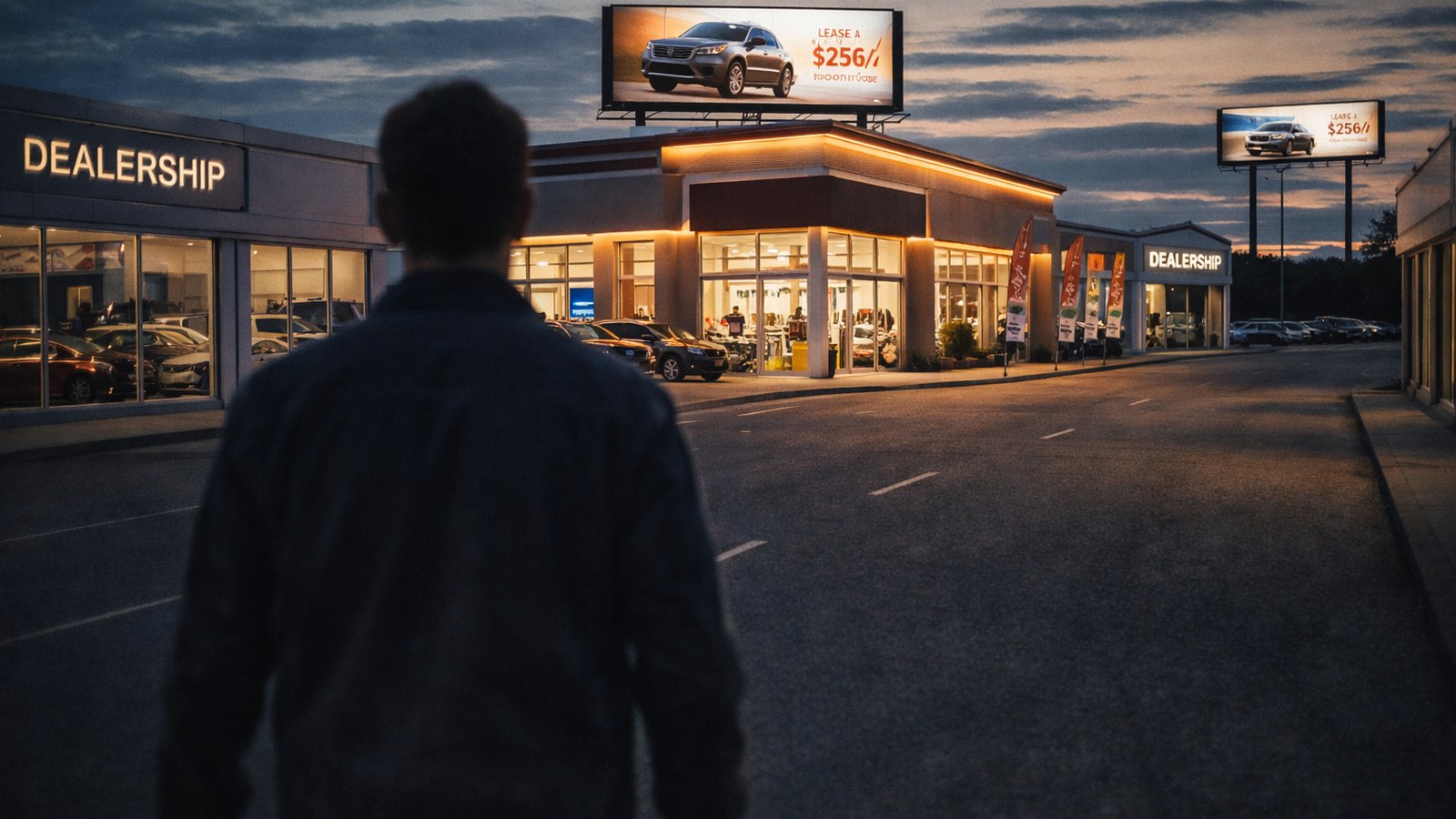
1. The Thesis
Open five dealership websites in the same OEM brand. Change the logo and city name on each one. Can you tell which is which?
For most franchises, the answer is no. The same template. The same stock photos. The same rotating hero banner with the same manufacturer incentive. The same "Why Buy From Us" section that says nothing specific.
When every competitor looks identical, what is the only variable left for a consumer to evaluate? Price.
This is not a branding lecture. It is an economics argument. When differentiation disappears, the market defaults to commoditization -- and in a commodity market, the lowest price wins. For dealerships operating on thin new-vehicle margins and facing tariff-driven cost increases, competing on price alone is not a strategy. It is a race to the bottom. We explore this dynamic in depth in why OEM templates keep you generic.
The dealers who build recognizable, trusted local brands create something their competitors cannot undercut: a reason to buy that has nothing to do with the number on the window sticker.
2. The OEM Template Trap
Franchise dealerships operate under a structural constraint that most other retail businesses do not: the manufacturer controls a significant portion of their customer-facing identity.
How it works
OEMs require dealers to use certified website providers -- typically a shortlist of 3-5 approved vendors. These vendors offer templates that conform to OEM brand guidelines. The result is a network of dealer websites that are, by design, interchangeable.
Co-op advertising programs -- which reimburse dealers for 50% to 100% of eligible advertising spend -- come with creative approval requirements that enforce OEM brand standards. The manufacturer's brand comes first; the dealer's brand is an afterthought.
As Bass Sox Mercer has documented, OEMs are "intentionally stepping into the sales process and encroaching on the autonomy of dealers to sell vehicles in the manner, and with the tools, that they believe to be most effective."
Why it costs dealers
When every dealer in your market uses the same website template, the same ad formats, and the same messaging, consumers cannot differentiate between them on anything other than price and proximity. The OEM's brand is well-served. The dealer's brand is invisible.
The uncomfortable truth: OEM co-op does not prevent you from building a brand. It prevents you from using OEM money to build a brand. The distinction matters. Your co-op dollars should cover OEM-compliant media. Your dealership's brand is built with your own investment -- in channels, content, and experiences that the OEM does not control.
3. What Brand Actually Means for a Dealership
For a dealership, brand is the answer to three questions:
- Recognition. When a consumer hears your dealership name, do they immediately know who you are, what you sell, and where you are?
- Trust. Do they believe that doing business with you will be a positive experience -- before they ever walk through the door?
- Preference. When choosing between you and the competitor three kilometres away who sells the same vehicles at a similar price, do they choose you first?
Brand is the shortcut that eliminates the need for comparison shopping. A consumer who trusts your dealership does not need to check three other dealers' prices.
The invisible cost of no brand
- Lower close rates. Customers with no brand affinity are harder to close because they have no reason to stop shopping.
- Higher advertising cost per sale. Without brand recognition, you need more impressions and clicks to generate the same number of opportunities.
- More price negotiation. When a consumer has no trust-based reason to pay your price, every deal becomes a margin compression exercise.
- Lower service retention. Customers who bought on price alone have no loyalty to your service department.
4. The Economics: What Brand Equity Is Worth
The retention multiplier
Bain & Company's research found that increasing customer retention by just 5% can boost profits by 25% to 95%. For dealerships where fixed operations often represent over 50% of gross profit, retention is the single most powerful financial lever.
According to Demand Local's analysis, 74% of customers who service their vehicles at the selling dealership are more likely to purchase their next vehicle from the same dealer.
The loyalty crisis
VehicleLyfe data shows that the rate of customers returning to a dealership for repeat purchases dropped 12% in 2024. Only about 20% of dealership sales come from repeat customers. Brand retention nationwide sits at approximately 43.9%, according to J.D. Power's 2025 study.
Willingness to pay premium
Academic research on brand experience and willingness-to-pay found that brand experience affects consumers' willingness to pay a price premium both directly and indirectly. When customers perceive a dealership as credible and differentiated, they are measurably more willing to accept a higher price.
5. How to Build a Dealership Brand That Stands Out
Tactic 1: Own a specific reputation
Every strong local brand is known for something specific. Not "great customer service" -- something concrete:
- The dealership that responds to every lead within five minutes, every time.
- The dealership whose service department never upsells unnecessary work.
- The dealership with the largest certified pre-owned selection in the region.
- The dealership whose owner knows your name and walks the showroom floor.
Tactic 2: Put real people in your marketing
OEM co-op ads feature stock photos. Your brand marketing should feature your people. A smartphone video shot in your showroom with genuine enthusiasm will outperform a studio-produced commercial with actors. Our video advertising guide covers exactly how to do this well. Authenticity is the currency.
Tactic 3: Create content the OEM cannot
- Local market guides. "Best family SUVs for Colorado winters"
- Staff spotlights. "Meet [Name], our master technician with 25 years of Honda experience"
- Community content. Sponsorships, local events, charitable work
- Educational content. "How to understand your lease-end options"
Tactic 4: Build a review moat
A dealership with 2,000 reviews and a 4.7 rating has a brand asset that competitors cannot replicate overnight. Systematize review requests. Respond to every review. Feature reviews in your marketing.
Dealership retention data shows that vehicle buyers using dealership apps are 73% more likely to purchase from that dealership and spend 7% more on vehicle purchases.
Tactic 5: Invest in channels you control
A strong social media presence, email, SMS, your website's blog, YouTube -- these are channels where you control the message. An email list of 10,000 past customers is a brand asset. A YouTube channel with 200 vehicle walkarounds is a brand asset. These appreciate in value over time, unlike paid impressions that expire when you stop spending.
6. Case Examples: Dealers Who Built Lasting Brands
Dueck Auto Group -- Vancouver, BC (100 Years)
Dueck Auto Group was founded in 1926. They built their brand around three words -- Selection, Value, and Trust -- and delivered on them consistently for a century. The lesson: brand compounds over time when you are consistent.
Morrey Auto Group -- Burnaby/North Vancouver, BC (50 Years)
Morrey Auto Group has operated for approximately 50 years, now in their third generation of family ownership. Their brand advantage is specificity and vertical integration -- including their own Auto Body and Glass centres. Read the full Morrey Auto Group case study to see how this translates to results. Brand differentiation can come from operational decisions, not just marketing.
J&S Mitsubishi -- The TikTok Dealer
George Saliba of J&S Mitsubishi built a personal brand by livestreaming actual car negotiations to thousands of viewers. Radical transparency -- showing consumers exactly what the buying process looks like. The lesson: in a franchise system where the product is controlled by the OEM, the dealer's brand can be its most powerful competitive asset.
7. The Small-Market Counterargument
A fair objection: "We're in a small market. Everyone knows us. We don't need branding."
This is partially true and partially dangerous. Even in small markets:
- Digital research happens everywhere. A consumer in a small town still Googles your dealership before visiting.
- Conquest happens digitally. Competing dealers from larger markets can reach your customers through targeted digital advertising.
- Generational turnover. The dealer principal's personal relationships work for existing customers. They do not work for the next generation of buyers.
Brand matters in small markets -- it just takes a different form. It is less about marketing campaigns and more about ensuring that the trust you have built in person is visible and reinforced digitally.