

The Framework in 60 Seconds
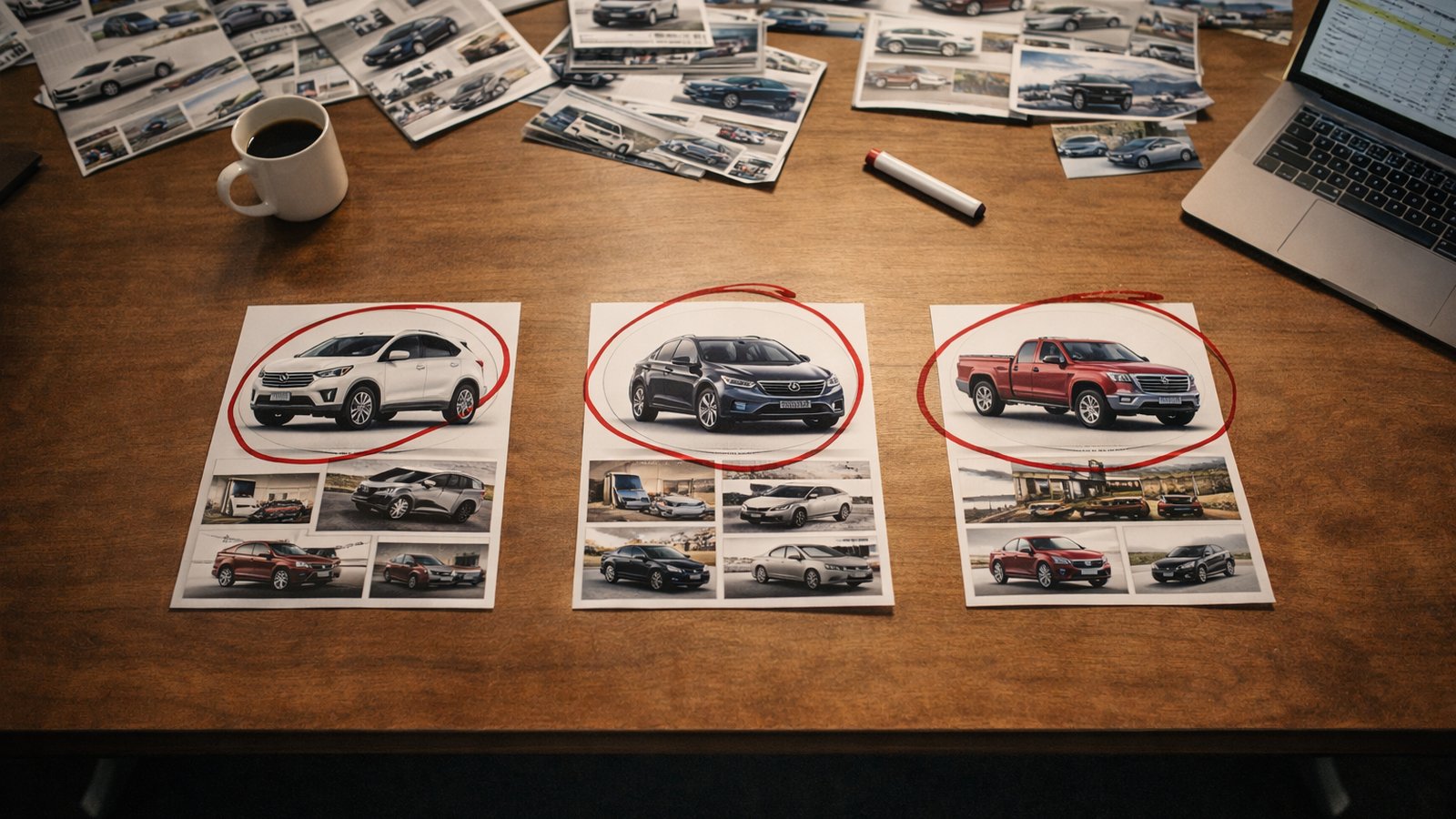
The Three Pillar Model is a dealership advertising strategy built on one observation: at every franchise store in North America, three models carry the month. Not eight. Not fifteen. Three.
A Nissan dealer sells 60% of their units across Rogue, Kicks, and Sentra. A Toyota store moves the bulk of volume on RAV4, Corolla, and Camry. Those are the pillars.
The framework is straightforward. Identify the three models that drive the majority of your gross and volume. Concentrate your advertising budget on those three across five execution channels — The Offer, Google Search, Catalog Ads, Display, and Video — covering every stage of the purchase funnel, what we call full-funnel domination. The remaining lineup gets baseline coverage. But the pillars get the lion's share.
The average new-car dealership in North America spends roughly $45,000 per month on advertising (NADA, 2024 data). Most of that budget is spread across every nameplate, meaning each model gets a few hundred dollars — not enough to win any auction, dominate any search term, or build any frequency. The Three Pillar Model fixes that math. For context on where that $45K should go, see The $20K Question and our guide to measuring real ROI.
Why Most Dealers Get This Wrong
The Problem With Equal Distribution
| Metric | Spray-and-Pray (15 Models) | Three Pillar Model (3 Models) |
|---|---|---|
| Monthly digital budget | $15,000 | $15,000 |
| Models receiving spend | 15 | 3 primary + baseline |
| Budget per model | $1,000 | $4,000 (pillars) + $1,000 pool |
| Google impressions per model | ~8,000/mo | ~35,000/mo |
| Impression share on model terms | 15-20% | 55-70% |
| Monthly leads per model | 4-8 | 18-30 |
| Cost per lead | $125-250 | $45-80 |
At $1,000 per model, you are not outbidding anyone on Google for "2026 Nissan Rogue near me." At $4,000 concentrated on a single model, you can dominate impression share for that nameplate in your market.
Identifying Your Three Pillars
Step 1: Pull 90 Days of Sales Data
Sort by units sold, not gross. You need volume movers — models that reliably deliver 15, 20, 30+ units per month. Two or three models will be responsible for 50-65% of your total new-unit volume.
Step 2: Check Inventory Depth
A pillar model needs adequate inventory. Aim for at least 45-60 days of supply on each pillar.
Step 3: Validate Market Demand
Cross-reference your sales data with Google Trends and search volume in your DMA.
Step 4: Evaluate Margin Contribution
Consider front-end gross, F&I penetration, and back-end contribution.
The Pillar Selection Matrix
| Factor | Weight | What to Look For |
|---|---|---|
| Units sold (90 days) | 30% | Consistent top 3 by volume |
| Inventory depth | 20% | 45+ days of supply |
| Search demand in DMA | 20% | Above market average |
| Gross profit per unit | 15% | Above-average front-end + F&I |
| OEM incentive support | 15% | Active rebates or co-op alignment |
The Five Execution Channels
1. The Offer
Funnel stage: Bottom of funnel. A model-specific landing page with the actual deal — payment, rate, trade value, incentive stack. Not a generic "view inventory" page.
2. Google Search
Funnel stage: Middle/Bottom. Model-specific search campaigns targeting high-intent keywords. Average CTR of 8.29% and conversion rates between 5.72% and 7.76% (WordStream, 2025). When you concentrate budget on three models, impression share rises from the low twenties into 55-70%.
3. Catalog Ads (Meta Automotive Inventory Ads)
Funnel stage: Middle. Dynamic ads that pull specific vehicles from your inventory feed. Meta's Advantage+ targeting has delivered 29% lower cost per lead for focused model strategies.
4. Display Ads
Funnel stage: Top of funnel. Display builds the frequency that makes your Search and Catalog ads convert. It is the assist channel.
5. Video Ads
Funnel stage: Top of funnel. 15- and 30-second video ads on YouTube, Meta Reels, and CTV. Video creates emotional connection and brand recall that display and search cannot.
Full-Funnel Mapping: How It All Connects
AWARENESS (TOF)              CONSIDERATION (MOF)           CONVERSION (BOF)
Video Ads -------->          Catalog Ads -------->          Google Search ----->  THE OFFER
Display Ads ------>          Google Search ------->          Catalog Retargeting >  (Landing Page)
                             Display Retargeting ->
Week 1-2: A shopper sees a YouTube pre-roll and a display ad. They are now aware your dealership has Rogues.
Week 2-3: That same shopper gets served a Rogue catalog ad on Instagram showing specific units with pricing. They click, browse your VDP, leave. They get retargeted.
Week 3-4: The shopper Googles "Nissan Rogue deals [city]." Your search ad appears. They click through to The Offer page. They submit a lead or call.
The Math: Concentrated vs. Distributed Spend
Same $15,000 budget. Distributed approach: 28 digital-attributed sales at $526 per sale. Concentrated approach: 51 sales at $296 per sale. That is an 81% increase in units and a 44% decrease in cost per sale. See the Morrey Auto Group case study for how this played out at a five-rooftop dealer group.
Results: What Dealers Actually See
- Cost per lead drops 40-60%. Higher impression share leads to better Quality Scores, lower CPCs, and higher conversion rates.
- Lead quality improves. A shopper who saw your Rogue video, was retargeted with a catalog ad, and clicked your search ad has been through three touchpoints.
- Total unit volume increases. Pillar models drive showroom traffic. A Rogue lead walks the lot and cross-shops your Pathfinder.
How to Implement This at Your Store
Month 1: Audit and Select
- Pull 90 days of DMS data. Identify your top three models by volume.
- Validate each against the Pillar Selection Matrix.
- Confirm at least 45 days of supply on each pillar.
- Brief your ad team or vendor on the three pillars. Reallocate budget.
Month 2: Build the Infrastructure
- Create model-specific offer pages for each pillar.
- Launch model-specific Google Search campaigns.
- Configure Meta catalog ads with pillar-model priority targeting.
- Produce at least one 15-second video per pillar.
- Set up display retargeting pools segmented by pillar model.
Month 3: Optimize and Measure
- Review cost per lead and cost per sale by pillar vs. non-pillar.
- Track showroom traffic sources.
- Monitor non-pillar inventory turnover.
- Adjust pillar allocation if one model outperforms.
Quarterly: Reassess Your Pillars
Review every 90 days. Do not change monthly — you need 60-90 days to see the full-funnel effect.