

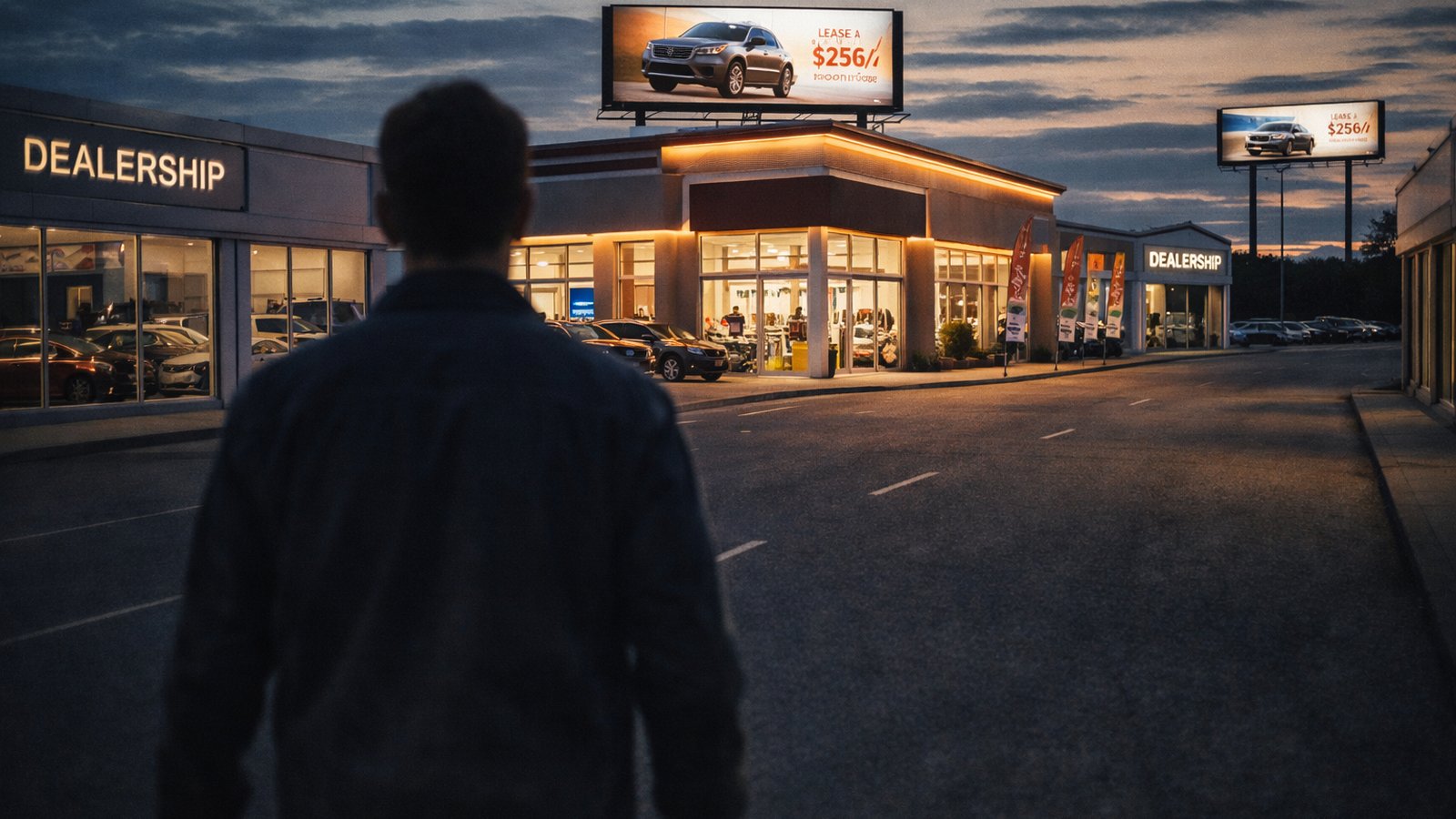
Every sales manager has heard the sentence. "The other store will do it for five hundred less." Sometimes it's true and sometimes it's a guess. Either way the manager has about a minute to match it or watch the customer leave.
Often the manager matches. It feels like a cost of doing business, and on one deal it is. What deserves a longer look is why the customer could say it at all. By the time she sat down, the price was the only difference between the two stores that anyone had shown her.
Two stores, one listing
Look at it the way she did, on a phone. Two dealers of the same make have the same model in the same trim. The photos are the manufacturer's on both pages, and so is the payment offer. Even the two websites could be cousins.
None of that is a fault. The manufacturer builds the vehicle and has every reason to present it one way across the country, and its advertising is a large part of why she is shopping that make at all.
It does leave her two lines that differ. One is the price. The other is the length of the drive. A shopper can only compare what she can see, so she does the sensible thing and sorts by price.
What a year of matching costs
Run the sum on your own store. Take last month's retail units, new and used, and multiply by five hundred dollars. With round numbers, a store that retails 80 vehicles and gives up $500 on each has given up $40,000 of front gross in a month. Over a year that is close to half a million dollars.
Not every deal goes that way. Cut the figure in half, or to a quarter. Then set it beside what the store spent last year on advertising about the store itself, as opposed to a vehicle or an offer. The second number is often hard to find at all.
A brand is what a customer can repeat
The word "brand" sends dealers to the logo. Leave the logo alone. For a dealership, the brand is what a customer says when her brother-in-law asks where she bought it, and why there.
The second half is the test. If she can answer it with something other than the price, the store has a brand. If she can't, it has an address.
The trouble is that most stores hand her the same three lines. Family owned, customers first, serving the community since some year. Each may be true. Every store on the strip says them, so they cancel, and she's back to the number.
A promise has to cost the store something
What a customer repeats is a promise specific enough to be broken. The price on the windshield is the price for everybody. Bring it back within a week if it isn't right. Yours will be something else.
What these share is a cost. Each takes money out of the store, or room to move, and that is why a competitor can't copy it by Friday. An adjective is free, so everyone has one.
Nobody can copy what is already true, either. The years the name has been on the sign. The service advisor customers ask for by her first name. The minor hockey sweaters with your store across the back.
Choose one and say it everywhere. A store that says five things is remembered for none of them.
The offer ends on the thirtieth and the name does not
There's a reason this rarely gets funded. An offer works inside a month. It starts on the first, gets counted on the thirtieth and is replaced.
A name works over years. It brings a customer back for her second vehicle, and later her daughter for a first. The month has no line for that, so in every budget meeting the name loses to something that can be counted by the thirtieth, and the store stops building it without anyone ever deciding to.
Manufacturer money tilts the same way, and fairly. Co-op exists to advertise the vehicles and the current offers. The part about your store is yours to pay for. Keep the offers on the three models that carry the month, and put something behind the name every month as well, even when it's small.
The desk and the service counter keep the promise
An ad can only make the promise. If the ad says one price and the desk comes back with a second pencil, the customer has learned that the promise was advertising. She'll tell the brother-in-law that instead.
So the sentence has to be the same in the ad, at the desk and at the service counter two winters later. Most of a store's name is made in service, one visit at a time, long after the campaign that started it has been forgotten. Tell your staff first.
The name on the building belongs to somebody
At a great many stores the name on the sign is a family's. Where it isn't, the people inside have still spent years earning what the town thinks of the place. They genuinely care how a customer is treated. It shows.
An ad that shows a vehicle and a payment tells the market none of that. It asks those people to be interchangeable with the staff of every other store that has the same vehicle. They are not. The customer has no way to know it until somebody tells her.
Have your own people finish one sentence
This week, give the same line to four people in the building, separately, and have each finish it in writing: "People buy from us, and not from the other store with our badge, because..." Make them the sales manager, a service advisor, the receptionist and a technician. Write one yourself.
Lay the answers side by side. If they match and none of them mentions price, you have your sentence. Pull last month's ads and count how many of them said it.
If they don't match, the market hasn't heard one either. Pick the answer that is already true and that costs you something to keep. Then do the five-hundred-dollar sum again. You'll know what that sentence is worth to the store.