

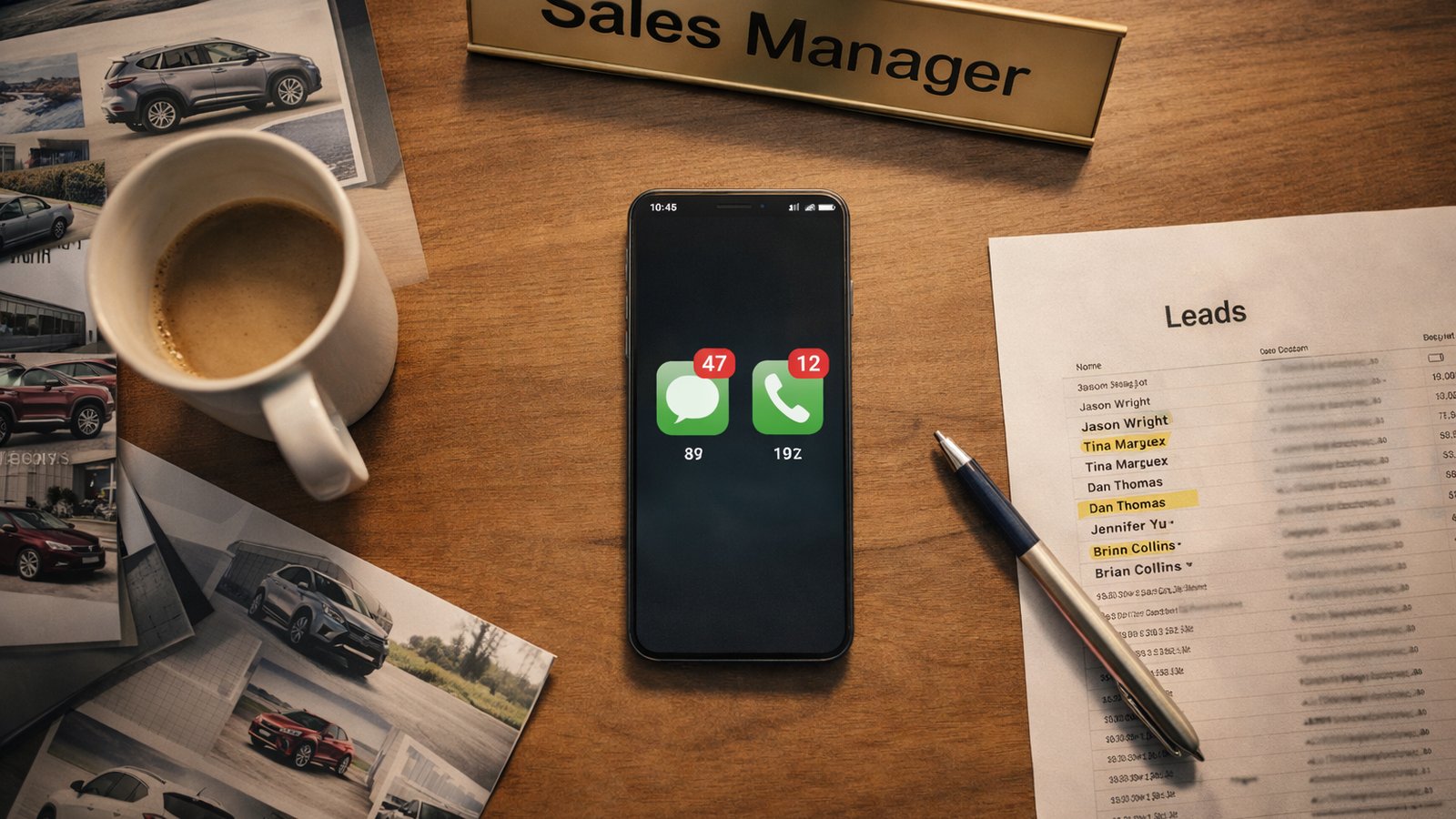
Forty-three percent of dealership sales leads are mishandled. Not slow-played. Not deprioritized. Mishandled — meaning they either received no meaningful follow-up or were never logged in the CRM at all. That number comes from the Foureyes 2025 Automotive Dealer Benchmarks Report, which analyzed 1.1 billion dealer website visits and 30 million pieces of inventory across 22,500 dealership websites using 2024 calendar-year data.
If your store generates 400 internet leads per month, that means roughly 172 of those leads are falling through the cracks every single month. Not because the leads were bad. Because nobody worked them.
At an industry-average close rate and gross profit per deal, that is not a process gap. It is a six-figure revenue leak running twelve months a year — invisible unless you know how to measure real marketing ROI. And most GMs do not know it is happening.
Where the Data Comes From
The 43% figure deserves scrutiny, so let's unpack it. Foureyes is a sales intelligence platform that tracks buyer behavior on dealership websites and matches it against CRM activity. Their finding: 43.2% of sales leads were mishandled. The breakdown:
- 14.1% of leads were never logged in the CRM at all. They came in through the website and simply vanished. No record. No follow-up.
- Website phone calls were the worst offender. Among leads that were never logged, 26.3% originated from calls placed directly from the dealer's website.
- The remaining ~29% were logged but received inadequate follow-up — a single email with no phone call, a delayed response, or a generic template.
Corroborating Data
- Pied Piper's 2025 Internet Lead Effectiveness Study — mystery-shopper inquiries through 4,023 dealership websites: 19% scored below 40 on a 100-point scale, meaning they failed to personally respond at all.
- DAS Technology's 2025 Lead Response Study — 1,700 dealerships: while 61% responded within 15 minutes, 19% took over an hour, and response quality was poor: 91% excluded payment details, 90% omitted photos, 74% skipped pricing.
The Real Dollar Cost
Let's do the math. Each input comes from a published industry source.
| Input | Value | Source |
|---|---|---|
| Monthly internet leads | 400 | DealerKnows benchmark |
| Mishandled rate | 43% | Foureyes 2025 |
| Leads lost per month | 172 | 400 x 0.43 |
| Average close rate | 8% | Urban Science / Foureyes |
| Average total gross per deal | $5,000 | Haig Partners Q4 2024 |
| Average cost per lead | $250 | Invoca / Turbo Marketing |
The Revenue Math
- 172 mishandled leads x 8% close rate = ~14 deals lost per month
- 14 lost deals x $5,000 avg gross = $70,000 in lost gross profit per month
- Annualized: $840,000 in lost gross profit per year
The Acquisition Waste
- 172 mishandled leads x $250 cost per lead = $43,000/month in wasted marketing spend
- Annualized: $516,000 in lead acquisition costs with zero return
Combined annual impact per rooftop: approximately $1.36 million.
Why It Happens
The instinct is to blame people. But the problem is structural, not personal.
1. Volume Exceeds Capacity
A BDC rep handling 50 to 80 active leads cannot physically respond to every new inquiry within five minutes. When leads cluster between 6 PM and 9 PM, there is often no one available to respond at all.
2. Phone Leads Are the Biggest Blind Spot
Website-originated phone calls are the single largest category of unlogged leads. A customer clicks the phone number on your VDP, speaks with someone for three minutes, and the call is never entered into the CRM.
3. After-Hours Is a Dead Zone
Most BDC operations run 8 AM to 7 PM. Consumer shopping behavior does not follow that schedule — 56% of leads arrive after hours. An autoresponder email is not a response — it is a placeholder.
4. CRM Workflow Gaps
Many CRM systems are configured to create lead records from form submissions but not from chat sessions, Facebook leads, or inbound calls. This is the fragmented operating system problem in action. If the integration is broken, leads enter the ecosystem but never enter the system of record.
5. Lead Quality Assumptions
Some managers assume 40% of internet leads are "junk." This becomes self-fulfilling. Foureyes data shows that among properly worked leads, 60% of eventual buyers closed within three days of their initial inquiry.
The Response Time Curve
The 5-Minute Window
Key findings from the MIT/InsideSales.com study (15,000+ leads, 100,000+ call attempts):
- The odds of contacting a lead drop 100x between the 5-minute mark and the 30-minute mark.
- The odds of qualifying a lead drop 21x over that same window.
- Calling within 60 seconds produced a 391% improvement in contact rate versus two minutes (Velocify).
The Conversion Decay Table
| Response Time | Relative Contact Rate | What Happens |
|---|---|---|
| Under 1 minute | Maximum (391% vs. 2-min baseline) | Customer is still on your site. Highest engagement. |
| 1-5 minutes | Very high | Still in shopping mode. You are likely the first dealer to call. |
| 5-30 minutes | Drops 10-21x | Customer has moved on to other listings. |
| 30-60 minutes | Drops dramatically | Customer is comparing responses. First-mover window closed. |
| 1-24 hours | Near baseline | Lead is cold. You are one of several dealers competing. |
| 24+ hours | Minimal | Customer has bought elsewhere or disengaged. |
What the Top 10% of Dealers Do Differently
1. They Treat Response Time as a KPI, Not a Guideline
Top stores measure time-to-first-response the way they measure gross or CSI — as a number that gets reviewed daily.
2. They Cover Every Hour the Customer Is Shopping
Whether through extended BDC shifts, outsourced after-hours teams, or AI-powered agents, top-performing dealerships have eliminated the dead zone between 7 PM and 8 AM. Our AI BDC vs. human BDC analysis breaks down the cost and performance of each approach.
3. They Log Everything — Especially Phone Calls
The 14.1% of leads that vanish from the CRM represent the easiest fix and the biggest blindspot. Top stores use call tracking that automatically creates CRM records.
4. They Personalize the First Touch
The first response includes the customer's name, the specific vehicle they asked about, a price or payment range, photos, and a clear next step.
5. They Follow Up Beyond Day One
The top 10% run structured follow-up sequences that extend 30 to 45 days, with cadence and messaging that evolves based on the customer's behavior.
6. They Audit Continuously
Top-performing dealer groups submit test leads monthly and grade the response on speed, personalization, and completeness.
The AI Solution
What AI Solves in Lead Response
- Instant response, every hour. An AI agent can respond within seconds — 24/7. This eliminates the after-hours dead zone entirely.
- Personalization without labor cost. An AI system connected to your inventory and CRM can generate a first response that includes the customer's name, the specific vehicle, current pricing, and a booking link.
- Automatic CRM logging. Every interaction is logged automatically. The 14.1% of phantom leads disappear as a category.
- Persistent follow-up. AI does not forget to follow up on day 7, day 14, or day 30.
- Scalable without headcount. Volume spikes do not degrade response quality.
What AI Does Not Solve
AI is not a replacement for a skilled salesperson in the showroom. It does not replace the F&I manager, the service advisor, or the GM's judgment. What it does is ensure that the buyer walks through the door in the first place — by making sure every lead gets a fast, relevant, personalized response regardless of when it arrives.